
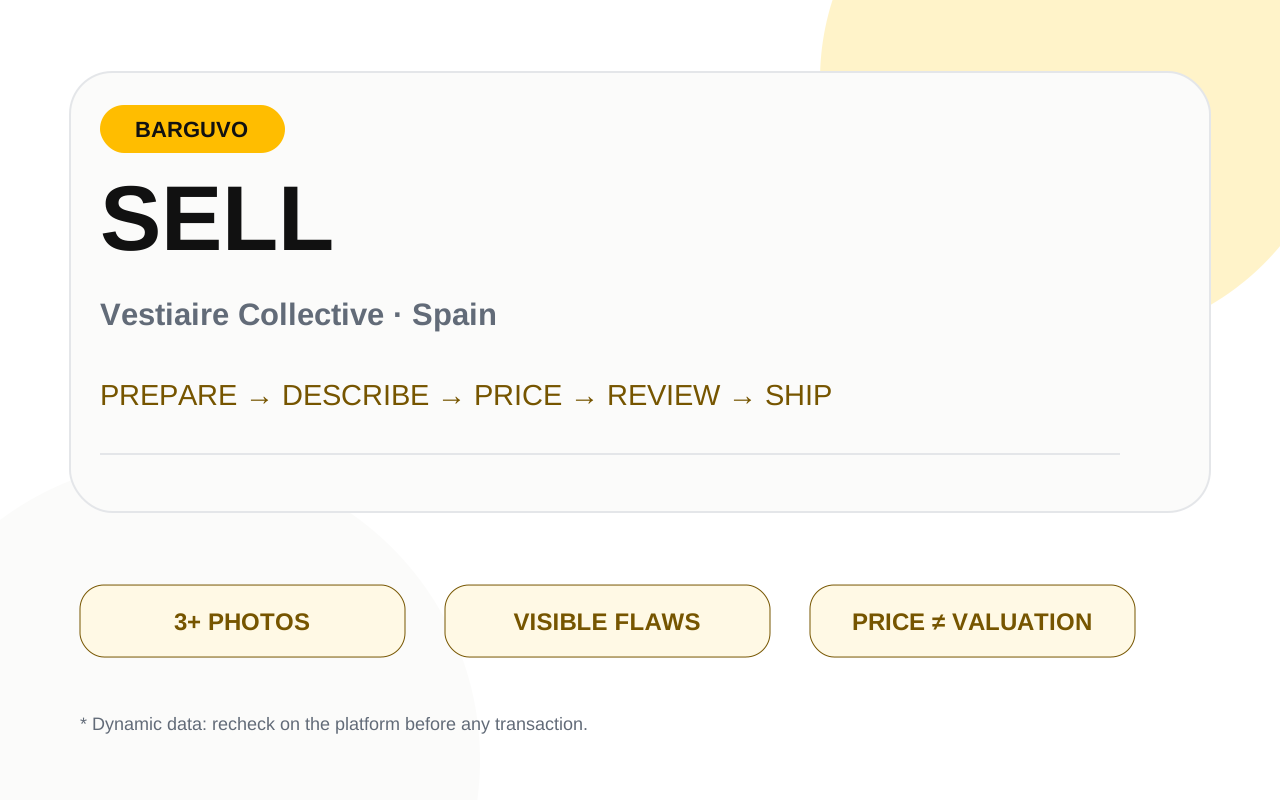
When does it make sense to sell here?
Practical decision and evidence before carrying out the transaction.
Vestiaire Collective is focused on second-hand fashion and uses a listing review layer before a listing goes live. That makes preparing the information well more important than trying to “optimise” the text with promises. Brand, category, size, material, condition, provenance and photographs must be consistent with one another.
From Spain you can treat the platform as the place where the transaction is carried out and Barguvo as a preparation and analysis layer. Barguvo does not upload the item, does not accept offers and does not create platform labels. Its role is to help you spot gaps, separate evidence from assumptions and reach the form with a more consistent description.
Brand, model, condition and identifiable details.
Clear photos of the whole item, labels, materials and defects.
ASKING price and negotiation margin defined before listing.
Identify the item before writing
Practical decision and evidence before carrying out the transaction.
Start with what you can observe or document. If you know the exact model name, use it; if not, do not fill the gap with the closest look-alike. In luxury fashion, two visually similar variants can differ a lot in price and expectations. The category and attributes help the digital review and the buyer understand what is being offered.
Check size, material and measurements when relevant. If a measurement is home-made, explain how you took it. If an accessory, box, dust bag or strap is not included, avoid photographing it in a way that makes it look part of the sale. If a piece has been repaired or modified, describe it in factual language.
Photos: current minimum and visual honesty
Practical decision and evidence before carrying out the transaction.
Vestiaire Collective’s Spanish help pages currently require a minimum of 3 photos and recommend well-lit images, including any defect. Three is a technical minimum, not a recommendation of sufficiency: a complex piece may need many more views to show front, back, sides, interior, label, hardware, a visible number or code where applicable, accessories and wear.
Photography should increase understanding, not erase evidence. You can improve the shot with light, framing, a physical background and stability, but you must not make a stain disappear, change the real colour, straighten a material deformation or invent accessories. Barguvo’s global rule still applies: improving presentation never allows misrepresenting the product.
Shows shape, proportion and general condition.
Label, material, fastenings, seams, hardware or relevant features.
Scratches, stains, scuffs, repairs, wear or visible missing parts.
A pretty photo does not replace an evidential photo
If a retouch changes the reasonable conclusion about condition, apparent authenticity or accessories, that edit is not acceptable to Barguvo.
A description that reduces ambiguity
Practical decision and evidence before carrying out the transaction.
The description must answer the questions that could change a purchase: what exactly the piece is, what condition it is in, what it includes, what it does not include and what defects or interventions there are. Avoid absolute adjectives such as “perfect” if there are signs of use. “Good condition” is more useful when accompanied by concrete facts.
Vestiaire states that if the item does not match its description or photographs it may inform the buyer or cancel the sale. That is why text and photos should support each other. If a defect appears in an image, mention it; if you explain it in the text, make sure there is an image where it can be seen.
Price: a platform suggestion is not a Barguvo valuation
Practical decision and evidence before carrying out the transaction.
Vestiaire shows a price suggestion based on similar items sold. It is a platform signal and can be useful as a reference, but it must not be turned into a SOLD history reconstructed by Barguvo or into a professional valuation. Barguvo keeps ASKING, SOLD, ESTIMATE, BARGUVO_ESTIMATE and PROFESSIONAL_APPRAISAL separate.
Also define your minimum before enabling negotiation. Your listed price is ASKING. The future sale, if it happens, will be a different piece of evidence. The net amount you receive also depends on the applicable fees; that is why the listing price and the net income are never synonyms.
Digital review before publication
Practical decision and evidence before carrying out the transaction.
After you create the listing, Vestiaire reviews it. Its current help pages state that, if approved, it may go live within up to 48 hours. That review can detect catalogue problems, insufficient photos or information that needs clarification. Do not call it physical authentication: that happens at another stage and not all shipments follow the same route.
If they ask for more photographs or details, respond with evidence from the item itself. Adding an invoice or documentation can help put provenance in context, but an isolated document does not mathematically make a piece authentic. The authenticity guide explains that difference in more detail.
Fees and costs before accepting the price
Practical decision and evidence before carrying out the transaction.
Listing is free according to the current help pages, but a sale can generate a selling fee, processing and other layers depending on who buys, the flow and the applicable services. Do not repeat a fee table within this guide: use the dedicated fees guide, because that is the place that must be kept up to date when percentages or bands change.
Before confirming a price, look at the net amount the platform shows. A mathematical example from Barguvo helps you understand the structure, not replace Vestiaire’s real breakdown. If the official figure changes, the figure in the current flow prevails.
After selling: offers, shipping and authenticity
Practical decision and evidence before carrying out the transaction.
When there is a sale, stop thinking like the editor of the listing and move on to the real order. The shipping method may be Direct, with Authentication or Express depending on the item and the flow available. For sales that require the seller to ship, the current help pages use a 7-day deadline on the main routes; if it is not met, the order may be cancelled.
Use the label or instructions that Vestiaire provides where applicable and keep proof of handover to the carrier. Do not generate an “equivalent” label on your own if the order requires another route. If the item has to go through a hub, pack it bearing in mind that it will be handled, inspected and sent on.
Checklist before listing
Practical decision and evidence before carrying out the transaction.
Do one last pass without trying to sell the piece to yourself. Is the identification certain? Do the photos show everything that could change the decision? Does the text mention defects and modifications? Is the price ASKING and not presented as “real value”? Do you know your negotiation minimum? Have you checked the net amount after fees? Are you clear on how you will need to ship if it sells?
If an answer depends on “I will explain it later”, there is still information that can be moved into the listing. If an answer depends on dynamic platform data, do not freeze it: check it just before carrying out the transaction.
Barguvo prepares; Vestiaire executes
Listing, selling, accepting offers, getting paid, shipping and making claims are done on Vestiaire Collective through its authorised flows.
How to review listing quality after writing it
Practical decision and evidence before carrying out the transaction.
Read the listing in three passes. In the first, look for contradictions between title, attributes and photos. In the second, try to identify everything that could lead to a “not as described” claim: defects, size, accessories, material, colour or repair. In the third, remove claims you cannot back up. This method produces less decorative text and more verifiable information.
Then test the listing without knowing its story: could an outsider tell what you know from what you assume? Would they understand exactly what they will receive? Could they locate the defect mentioned? If not, add a photo or a concrete sentence. Do not make up for a lack of evidence with reassuring adjectives.
Finally, check the dedicated guides: fees, offers, shipping and authenticity change more than the general description. Instead of duplicating their figures, link to the corresponding guide. This structure reduces update debt and prevents two Barguvo pages from giving different answers.
Full example: preparing a piece without inventing certainty
Practical deep dive to reduce mistakes before acting.
Imagine a used bag from a well-known brand with a box, a dust bag and a small scuff on one corner. The right preparation starts by identifying the model only if there is enough evidence: consistent label, measurements, features and documentation. Then you photograph the whole bag, interior, base, hardware, label, included accessories and the scuff at a distance where it can be seen. In the description you explain that the scuff exists, where it is and that it does not prevent use. If the box is damaged, you say so; if the dust bag is not the original and you cannot prove it is, you avoid calling it original.
When setting the price, you can look at Vestiaire’s suggestion and at comparables, but you keep the ASKING price you choose separate from any closed sale you cannot verify. You also look at the current fee to know what net amount you would get and decide your minimum before enabling offers. If a proposal arrives later, you already know whether it is within your range without having to reinterpret the item under pressure.
If the listing is approved, the digital review does not change the status of the evidence: it is still an accepted listing, not a physical certificate. When it sells, you check the shipping method shown on that order and follow its instructions. This sequence means every decision is backed by the real piece and by the platform’s current flow.
Mistakes that seem small and end up costing a claim
Practical deep dive to reduce mistakes before acting.
One of the most frequent mistakes is using reference photographs that are not of the unit being sold. Even if they help to recognise the model, they can create expectations about colour, finish or accessories. Another is copying a description from another sale and leaving in a feature your piece does not have. It is also problematic to hide a defect with favourable framing and think it is enough to mention it vaguely at the end of the text.
The price can also create inconsistency. If you list high “to negotiate” but have not calculated the fees, you could accept an offer that looks good and then discover that the net amount does not meet your minimum. The solution is to calculate first, not improvise afterwards. In the same way, an automatic category or price suggestion must be checked against the item: a tool helps, but the seller is still responsible for the listing being accurate.
Finally, avoid moving a transaction off Vestiaire to save fees or speed up payment. Barguvo must not teach shortcuts that remove protections or rely on unauthorised automation. The aim is to prepare the sale better within the framework of the original platform.
Organise data, evidence, price, costs or a checklist before carrying anything out.
Listing, buying, selling, negotiating, shipping or making claims are done on Vestiaire Collective.
FAQ
How many photos does Vestiaire Collective require?
The current Spanish help pages require a minimum of 3 well-lit photos and images of any defect. For many pieces you will need more to document condition and details.
Which defects do I have to show?
Those that could reasonably change the decision, the price or the expected condition: wear, stains, scratches, repairs, missing parts, deformations or other relevant problems.
Is the price suggestion a valuation?
No. It is a platform suggestion based on its own signals, including similar items sold. Barguvo does not turn it into a professional valuation or into its own SOLD dataset.
How long does it take for a listing to be approved?
The current help pages state that, if approved, it may go live within up to 48 hours. This is operational information and may change.
Can I negotiate the price?
Yes, if the seller has the Make an offer feature enabled. The details and deadlines are in the dedicated offers guide.
What happens after selling?
You must follow the shipping method and deadline shown on the order. In the current main flows, the seller has up to 7 days to ship.
Can Barguvo list the item for me?
No. Barguvo can prepare and analyse the listing, but listing and every marketplace action are done on Vestiaire Collective.
Selling information revalidated on 25/08/2026. Before listing, confirm on the current listing form the requirements, costs, review and shipping method that apply to that specific piece.