
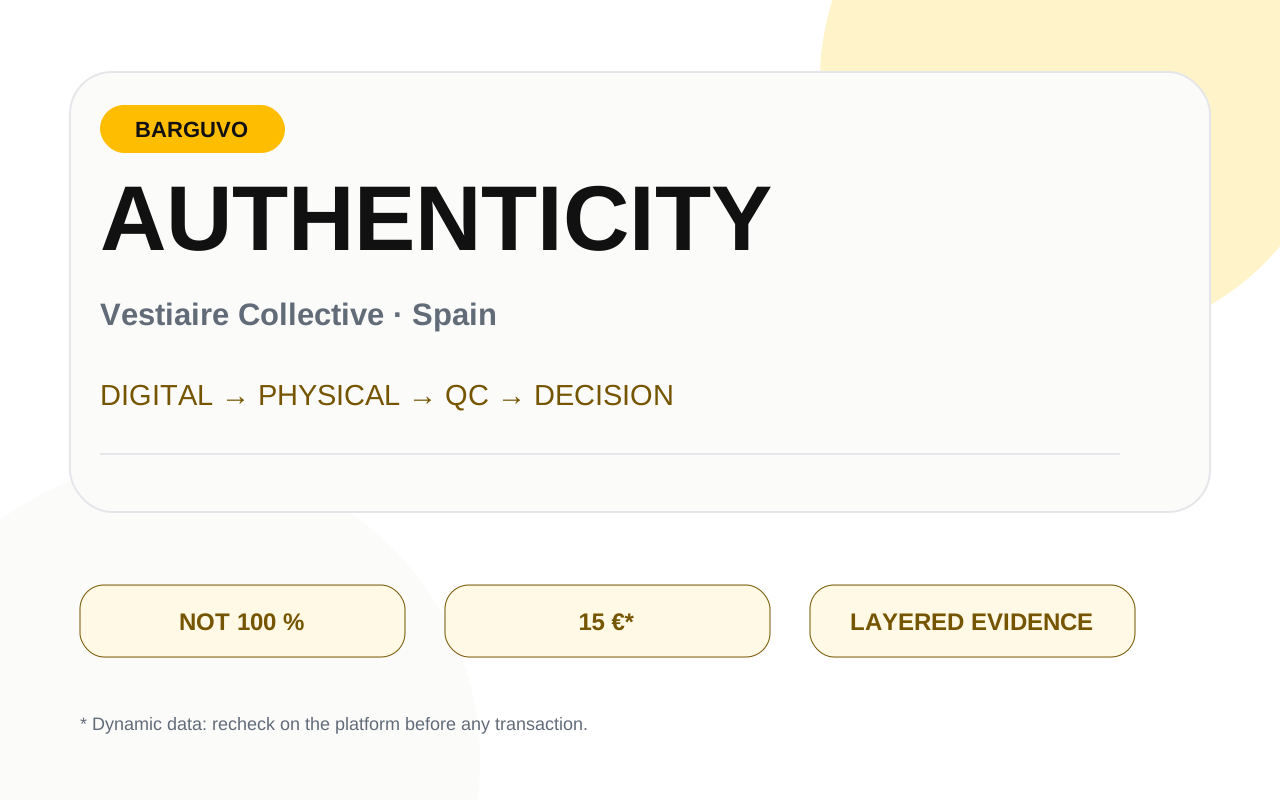
Three different questions
A practical decision and evidence before carrying out the transaction.
The listing review tries to decide whether the listing can be published and whether it has enough information. Digital checks work with data and images. Physical authentication requires the item to arrive at a hub and be examined. Quality control compares condition, colour, size, measurements or description with what was advertised. Grouping everything under “verified” erases important differences.
For Barguvo, a signal must keep the scope it actually has. A listing approval does not on its own prove physical authenticity. A physical authentication does not show that the seller is reliable in all their transactions. And a quality match does not turn an unknown provenance into a known one.
Analyses information/photos and may ask for more evidence.
Examination of the item when the flow includes it.
Checks conformity with the condition and description.
Before publishing: review and digital evidence
A practical decision and evidence before carrying out the transaction.
Vestiaire reviews listings before publishing them. If the photos do not allow the item to be assessed, it may ask for more material or reject the listing. The Spanish help requires at least 3 photos and highlights close-ups of labels, brand marks, flaws and a full image. This layer improves the quality of the listing, but it should not be described as a physical inspection.
Documents such as a receipt, invoice, certificate or provenance information can help. The help itself warns that the information provided does not guarantee authenticity; it contributes to the decision. Barguvo maintains the same caution: document ≠ conclusive proof on its own, absence of a document ≠ forgery.
Shipping with authentication: physical examination
A practical decision and evidence before carrying out the transaction.
When the order uses Envío con Autentificación (Shipping with Authentication), the item is sent to a Vestiaire centre. The current help describes a review by experts that may consider packaging, materials, typography, finishes, stitching and other features depending on the piece. The available service is currently charged at 15 € per item when that charge applies.
The examination should not be turned into a public list of “tricks to pass” an authentication. The value for the user is understanding what evidence they can prepare and what the result means. If an item does not pass the check, the order may be cancelled and the buyer refunded according to the flow.
Quality control is not the same as authenticity
A practical decision and evidence before carrying out the transaction.
Quality control compares the piece received with what the listing promised: condition, colour, size, material, accessories and other attributes. An authentic item can fail a conformity check if it does not match the description. Likewise, a correct description does not on its own answer the question of authenticity.
This distinction is especially useful when preparing a claim. If the problem is an undisclosed stain, the main issue is conformity. If the problem is a doubt about authenticity, the evidence and the route may be different. Naming the problem correctly helps avoid irrelevant arguments.
| Question | Main layer | What it does NOT prove on its own |
|---|---|---|
| Does the listing have enough information? | Review/listing | Physical authenticity |
| Does the piece appear authentic according to the examination? | Authentication | Complete reliability of the seller |
| Does it match what was advertised? | Quality control | Complete provenance |
No process should be sold as infallible
A practical decision and evidence before carrying out the transaction.
Vestiaire explains in its authenticity information that its processes aim to reduce risk, but no authentication process should be presented as mathematically perfect. Barguvo reinforces that limit: an “authenticated” label is relevant evidence within a process, not a licence to ignore later contradictions.
The reverse also applies: a visual anomaly does not prove forgery. Photos taken at an angle, wear, seasonal production, repairs or variants can produce differences. When in doubt, gather evidence and use the platform’s review process instead of making an absolute accusation.
UNKNOWN ≠ FAKE
If the evidence does not allow a conclusion, the correct status is unknown or inconclusive. Absence of proof is not the same as fraud.
Envío Directo: no prior physical inspection
A practical decision and evidence before carrying out the transaction.
With Envío Directo, the seller ships to the buyer without Vestiaire physically examining the piece before delivery. The platform keeps the listing review and claim mechanisms, but the route should not be described as if it had passed through the hub. Eligibility depends on price, item, seller and territory.
For a buyer, this changes which evidence is worth keeping on receipt: packaging, shipping label, the condition of the parcel and clear photos of the item. The current help allows Envío Directo problems to be reported within 72 hours in the flow described.
Barguvo evidence ladder
A practical decision and evidence before carrying out the transaction.
Order the evidence from weak signals to more specific signals without making any of them absolute. A catalogue photo or a visual resemblance contributes little. Your own photos of details, consistent documentation and traceability provide more context. A physical review by the platform is a strong signal within its scope, but it does not rule out the possibility of a later incident.
Do not publish personal data from invoices or documents to “prove” authenticity. If you need to use them in a review, share them only through the appropriate channel and minimise unnecessary data. Barguvo does not need to store real PII to explain how to organise a case file.
Brand, model, variant, declared provenance.
Your own photos, labels, finishes, consistent wear.
Outcome of a review or claim within the platform.
What to do if you still have doubts
A practical decision and evidence before carrying out the transaction.
If you have not bought yet, ask for information that could genuinely change your decision and avoid closing under pressure. If you have already received the item, identify the shipping method and the applicable deadline. Document the piece before handling it more than necessary and use the “report a problem” flow when appropriate.
Barguvo can help you structure a list of contradictions and evidence, but it should not declare a piece authentic or fake without sufficient grounds, nor replace the decision of Vestiaire or a specialist professional.
How to write about authenticity without creating false security
A practical decision and evidence before carrying out the transaction.
Avoid three extremes: “if it is on Vestiaire it is authentic”, “if it has no invoice it is fake” and “if a photo does not match, it is a forgery”. All three turn incomplete signals into conclusions. A better formulation describes what was checked, when and with what limits.
If a listing mentions an authentication process or service, check whether it refers to that unit and that order. Do not carry over the result of a previous sale to a different piece. Likewise, an account with many sales does not automatically authenticate every future item.
Barguvo must keep the possibility of UNKNOWN. That label is not a weakness: it prevents the system from fabricating an accusation or a guarantee when the evidence falls short.
An example of layered reading when facing a real doubt
A practical deep dive to reduce mistakes before acting.
Suppose you receive a bag via Envío Directo and a seam looks different from the brand’s official photos. The right reaction is not to conclude “it is fake”. First confirm that you are comparing the same variant, season and size. Then check the listing photos to see whether the detail was already visible. Document the seam, label, hardware and any other feature that justifies the doubt, without editing the images.
As the order was Direct, there was no prior physical authentication at the hub. That does not prove it is fake; it simply changes the available evidence. If you are within the applicable deadline, you open an incident and explain the specific discrepancy. Vestiaire may ask for the piece to go through review. The result of that process adds a new layer of evidence.
If, on the other hand, the piece has already been through authentication and QC, that fact is relevant and should be included in the analysis. But if a material contradiction appears later, you should not ignore it just because of the earlier result either. The Barguvo methodology keeps both: a strong signal in favour and new evidence that deserves review.
Language that avoids accusations and false guarantees
A practical deep dive to reduce mistakes before acting.
Use expressions such as “I cannot confirm”, “this detail does not match the reference I have”, “requires review” or “the evidence is insufficient”. Reserve “fake” or “authentic” for situations where there is a basis that genuinely allows that conclusion, and make clear who is issuing it. This protects the user from hasty decisions and reduces potentially unfair claims.
The same happens on the seller’s side: “I have an invoice” should not become “guaranteed authenticity”. The invoice may support provenance; a physical authentication may provide another signal; a quality review answers another question. The quality of the analysis improves when each word keeps its scope.
Barguvo’s visual design must also respect this nuance. Do not use badges or seals that look like a certification of its own. Present statuses as available evidence, pending review or the result from a specific source, never as an absolute badge invented by Barguvo.
What decision Barguvo can and cannot make
A practical deep dive to reduce mistakes before acting.
Barguvo can say that the evidence is consistent, contradictory, incomplete or requires additional verification. It can also point out that a photograph does not allow a label to be read, that an invoice does not match in date or model, or that the chosen route does not include a prior physical inspection. These are observations about the quality of the evidence, not authenticity rulings.
Barguvo must not issue a certificate of its own or use a score that appears equivalent to professional authentication. If an authorised provider is integrated in the future, the result must clearly preserve who issued it, which piece it examined and with what scope. The interface must avoid iconography that suggests Barguvo replaced Vestiaire’s process.
The practical goal is to decide the next step: ask for a specific photo, not buy yet, open an incident, keep the item for review or go to a specialist. An answer that guides the next step can be very useful without claiming to know something the available evidence does not allow you to know.
Organise data, evidence, price, costs or a checklist before carrying anything out.
Publishing, buying, selling, negotiating, shipping or making a claim is done on Vestiaire Collective.
FAQ
Are all items physically authenticated?
No. The route depends on the shipping method and eligibility. Envío Directo, by definition, does not include a prior physical inspection at a hub.
What is the difference between digital verification and authentication?
Digital verification works with the listing, data and images; physical authentication examines the item when it arrives at a Vestiaire centre.
Is it 100 % infallible?
It should not be presented that way. It is a process of risk reduction and expert assessment, not an absolute mathematical guarantee.
What do the experts check?
Depending on the piece, they may analyse materials, typography, finishes, stitching, packaging and other features, as well as a quality check against the description.
Does an invoice prove authenticity?
It provides context and can help, but the help itself states that the information provided does not on its own guarantee authenticity.
What happens if it does not pass the check?
In the authentication flow, Vestiaire may cancel the order and refund the buyer according to the result and the applicable conditions.
What do I do if I still have doubts after receiving it?
Keep the evidence, check the shipping method and the applicable deadline, and open Vestiaire’s incident flow when appropriate.
Verification and authentication processes revalidated on 25/08/2026. The route and the fee depend on the service actually applied to the order; always check the current screen.