
First: separate who pays what
Practical decision and evidence before carrying out the transaction.
Talking about “the fee” mixes several things. The private seller may pay a selling fee and processing. The buyer faces a service fee that varies and may have a minimum. Authentication may have a cost on certain routes. Professional sellers use a different structure. Shipping, customs and taxes are yet another layer.
This separation avoids two common mistakes: calculating the seller’s net using a buyer fee, and comparing an old example with a listing created under new fees. In June 2026 Vestiaire changed the private seller scale for new listings, so archived pages should not be used for a listing created today.
Selling fee + processing under the current rule.
Service fee + possible services/costs of the order.
Auth, shipping, customs or taxes where applicable.
Private seller in EUR: current snapshot
Practical decision and evidence before carrying out the transaction.
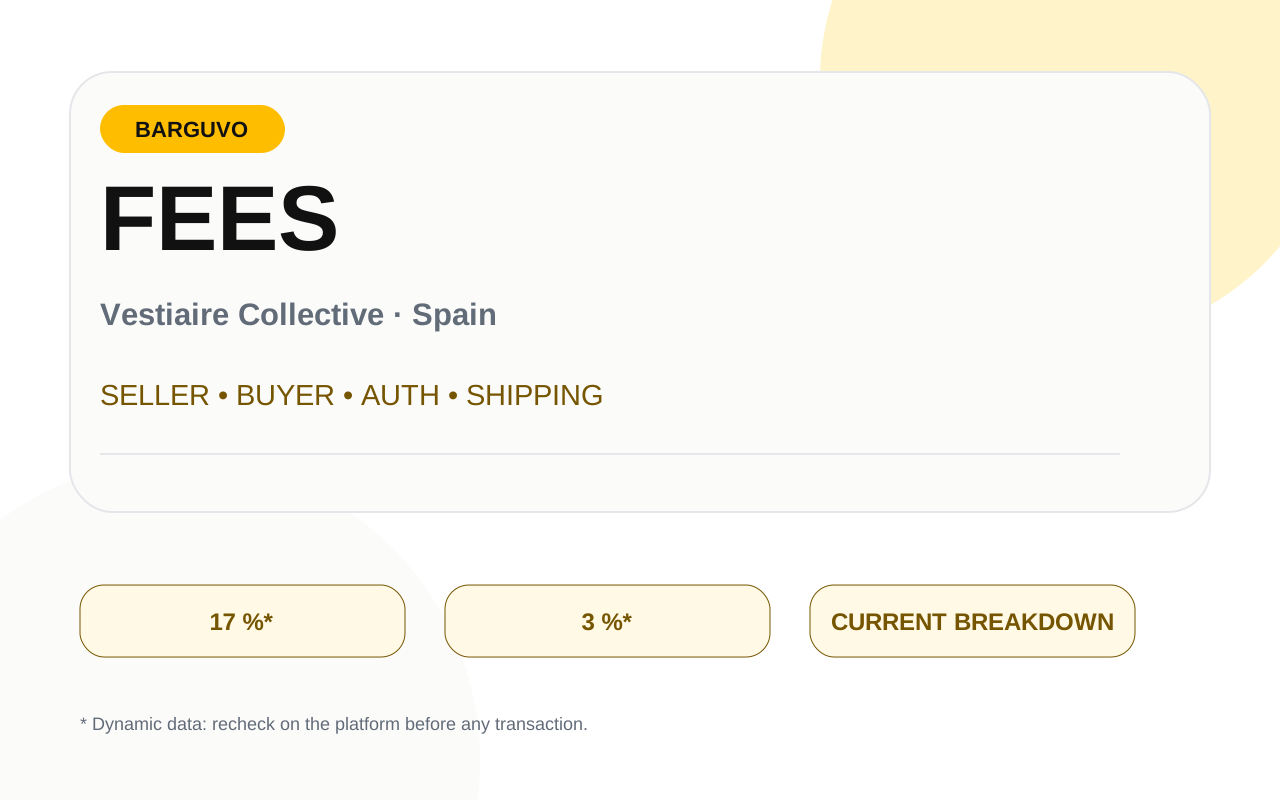
The current Spanish help states that listing is free. For new listings from 9 June 2026, items priced in EUR between 75 € and 15.000 € have a 17 % selling fee. Below 75 € a fixed fee of 12 € is used, and above 15.000 € a fixed fee of 2.500 €.
In addition, a 3 % payment processing fee is charged on the sale; for items below 75 €, the help states 3 €. The same source notes that it does not accept items with a selling price below 16 €. These data belong to the current Spanish help and should not be extrapolated to other currencies or locales.
| Item price in EUR | Selling fee | Processing |
|---|---|---|
| < 75 € | 12 € fixed | 3 € fixed |
| 75 €–15.000 € | 17 % | 3 % |
| > 15.000 € | 2.500 € fixed | 3 % |
Worked examples: to understand, not to promise
Practical decision and evidence before carrying out the transaction.
Synthetic example: if a private seller lists an item today at 500 € and it sells for exactly 500 €, a literal application of 17 % + 3 % would produce 85 € of selling fee and 15 € of processing, before any other applicable layer. The illustrative net would be 400 €. This calculation teaches the structure; it does not replace the final amount Vestiaire shows for that transaction.
A 60 € item falls into the fixed band: the example would use 12 € of selling fee and 3 € of processing. But even here it is worth looking at the net shown on the platform: the terms may be updated, some categories or accounts may have specific conditions, and the buyer faces charges that are not the seller’s income.
ASKING ≠ NET
The listed price is the amount asked for the item. The net is what remains after the applicable fees. Do not use a phrase like “you keep 80 %” outside an example with explicit assumptions.
Buyer service fee
Practical decision and evidence before carrying out the transaction.
Vestiaire’s current international help describes a buyer service fee that normally ranges between 5 % and 28 % of the item price, with a minimum of 5 EUR/GBP/USD/CHF or equivalent. The specific percentage depends on factors such as currency and seller type and is shown in the price breakdown and at checkout.
For someone in Spain, do not turn that range into a formula for predicting each order. If a listing shows the breakdown, that specific value is more useful than an average. In addition, the buyer fee should not be subtracted again from the seller’s income unless the platform itself presents it as part of its net calculation.
Authentication and other costs
Practical decision and evidence before carrying out the transaction.
The current Spanish help publishes a 15 € authentication fee for items shipped with authentication in cases where that charge applies. It also states that, if Envío Directo (Direct Shipping) is not available, physical authentication may be included in the buyer service fee. That is why 15 € should not be automatically added to every order.
Shipping and customs are not synonyms for fees either. Shipping costs depend on the delivery country, the price and the seller’s location. In international purchases, duties, import IVA (VAT) or handling charges may appear. The platform shows the applicable amounts at checkout where relevant.
Professional seller: do not copy the private table
Practical decision and evidence before carrying out the transaction.
Vestiaire maintains a specific structure for professional sellers. The current help points to fees updated from 26 June 2026 and distinguishes a standard and a reduced commission, linked, among other factors, to the monthly refund rate. That is enough to conclude that a private seller table should not be reused for a professional account.
If you operate as a business, check the professional table for your currency and account before making margin decisions. This guide does not freeze a specific professional commission because the owner is the fee structure, not a universal promise for all accounts.
How to calculate a net amount without hiding assumptions
Practical decision and evidence before carrying out the transaction.
Start with the price you actually expect to close at, not necessarily the ASKING price. Then apply only the fees that correspond to your seller type and the current price. Add external costs only if you know you will bear them. Separate taxes or business expenses from platform fees. Finally, compare the net with your acquisition, preparation and shipping costs, if any.
Barguvo can do this calculation with values entered by the user or revalidated. It must not scrape the checkout without authorisation or assume that today’s band will still apply months later. For relevant decisions, keep the date and source of the data.
What you should revalidate just before selling
Practical decision and evidence before carrying out the transaction.
Check the Spanish private seller fees page, your listing’s breakdown and, if you are a professional, the current professional table. For purchases, look at the service fee for that specific item. For authentication, check which route appears. For shipping and customs, use the real checkout or order.
The figures in this guide are dated 25/08/2026 and serve to explain the system. A figure Vestiaire changes tomorrow does not invalidate the architecture: it invalidates the snapshot. That is why Barguvo keeps a freshness log and avoids hiding dates in examples.
Do not mix locales
A page in French, for the United Kingdom or the United States, or a historical archive may show a different figure. For Spain and Spanish copy, prioritise the current Spanish help and the account’s real flow.
Fees as decision data, not decoration
Practical decision and evidence before carrying out the transaction.
A fee only matters if it changes a decision. For a seller, it may determine the minimum acceptable offer. For a buyer, it changes the total cost compared with another platform or a local purchase. For a professional, it affects margin and inventory policy. That is why Barguvo should show the formula and the context, not just a big percentage.
When you compare marketplaces, use the same scenario: same selling price, same seller type and equivalent costs. Do not compare one platform’s seller fee with another’s total buyer fee. If one service includes authentication or logistics that another charges separately, note it as a difference in scope.
In a future update, the system should be able to replace fee bands from a registered source without touching the conceptual copy. That separation between “live rule” and “stable explanation” is one of the reasons for keeping the FEES owner independent.
Three scenarios to understand why the same sale does not always cost the same
A practical deep dive to reduce mistakes before acting.
Scenario A: private seller, a 500 € item and a buyer in a flow with no extraordinary costs. Here the conceptual calculation starts from the current private seller band and processing. Scenario B: same price, but the buyer needs a service or route that includes authentication, international shipping or taxes; the buyer’s total cost changes even though the seller’s ASKING price is the same. Scenario C: professional seller; the structure is no longer the private table and may depend on updated professional rules.
These scenarios show why Barguvo should present layers. If a user asks “what fee does Vestiaire charge?”, a responsible answer first asks from which perspective. For the seller, the net matters. For the buyer, the total matters. To compare platforms, what matters is including equivalent services and not counting twice a fee that is already in the breakdown.
The listing date also matters. The Spanish help distinguishes fees applicable to new listings from 9 June 2026 and keeps historical archives for earlier periods. An item created before a change could have different conditions from one created afterwards. The date and the listing’s own breakdown are part of the evidence.
How to audit a figure before using it in Barguvo
A practical deep dive to reduce mistakes before acting.
First, check that the source is current and not marked as an archive. Second, confirm that it corresponds to the locale and currency you are going to explain. Third, identify whether it refers to a private seller, a professional or a buyer. Fourth, check the effective date. Fifth, compare the figure with what the specific transaction shows when you have legitimate access to it.
If two current sources do not match, do not choose the one that seems more convenient. Record the conflict and reduce the public precision until it can be resolved. The same principle is used in the offers guide with the counter-offer timers. An imprecise but honest figure is better than an invented exact one.
For the product, fees should be stored as versioned configuration with a country/site gate, not written by hand on multiple screens. That way a future update can propagate without rewriting every editorial explanation. The guide keeps describing the logic even when the percentage changes.
Organise data, evidence, price, costs or a checklist before carrying out anything.
Listing, buying, selling, negotiating, shipping or claiming is done on Vestiaire Collective.
FAQ
Is listing free?
The current Spanish help states that putting an item up for sale is free; fees are deducted when the sale takes place.
How much does it charge a private seller?
For current new listings in EUR, the Spanish help shows 17 % between 75 € and 15.000 €, with fixed bands outside that range, plus processing. Revalidate before selling.
What is the processing fee?
It is a layer separate from the selling fee. The current help states 3 % in the main band and 3 € for items below 75 €.
What does the buyer pay?
There is a variable service fee, and shipping, authentication, taxes or customs may be added depending on the order. The exact breakdown is shown on the platform.
Does authentication cost extra?
Not always. The current help publishes 15 € in the applicable flow, but it also mentions cases in which physical authentication is included in the buyer service fee.
Do professionals pay the same?
No. Vestiaire publishes a specific professional structure with standard/reduced commissions and its own conditions.
Why might my final amount differ from an example?
Because an example freezes assumptions. Your account, price, currency, seller type, services and current fees may produce a different breakdown.
Fees revalidated on 25/08/2026. Bands and charges may change; for a financial decision, use the current Spanish page and the breakdown shown in the specific transaction.