
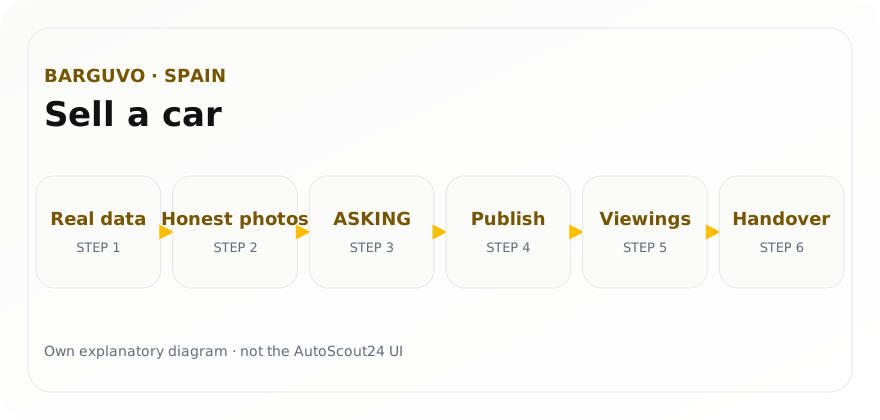
Selling a car on AutoScout24: what the current flow actually does
AutoScout24’s Spanish site currently offers a direct-sale process for private sellers that starts with the vehicle’s basic details and ends, outside the form, with conversations, viewings, negotiation, contract and handover. The visible promise is “Vende tu coche gratis” (Sell your car for free) and the benefit is spelled out as “Anuncio básico gratuito” (Free basic listing). That supports saying that the basic listing tier is currently free of charge, but it does not justify generalising that every additional AutoScout24 service is free. Premium and SafeTrade are separate layers and must be explained with their own terms.
The form asks for information such as make, model, first registration, body type, fuel, transmission, power, version and mileage. Filling in those fields properly is not cosmetic: they are variables other people use to filter listings and that the platform can use to put prices in context. The practical rule is simple: copy from the documentation where appropriate, check the detail on the car and avoid “filling in by intuition” a version, power output or equipment you have not verified.
Barguvo uses this guide to prepare a listing you can stand behind, not to replace the platform. The account, the listing, messaging with interested parties, any activation of SafeTrade and the sale contract remain on AutoScout24 or the relevant original service.
Preparation and photos: selling better without dressing up the car
AutoScout24 recommends preparing the car before listing it and being transparent about faults and accidents. For Barguvo, that transparency becomes a visual invariant: a photo can be better lit, straightened or framed, but it must not erase dents, scratches, wear, warning lights, colour differences, missing components or accessories that are actually fitted. If an edit changes the apparent condition of the vehicle, it is no longer a presentation improvement and starts to falsify the evidence.
Put together a set of photos that makes the unit recognisable: front and rear three-quarter views, sides, interior, instrument cluster, boot, wheels/tyres, the engine bay where relevant, labels or non-sensitive documentation and close-ups of material defects. If there have been significant repairs, the description must match what the images show. An old photo showing an earlier condition is not good evidence just because it is sharp.
Physical preparation must not turn into concealment either. Cleaning, vacuuming or tidying up is reasonable. Disguising a leak, clearing a warning without fixing its cause or using AI to rebuild a damaged part is not. The goal is for the first viewing to confirm what the listing had already said.
Starting price: using comparables without inventing a sold price
The selling page advises researching the price and negotiating. AutoScout24 also has valuation and price evaluation tools, but each one answers a different question. When you look at listings of comparable cars you are looking at ASKING: prices sellers are asking for. You do not automatically know whether those units will sell, whether they will be negotiated down, whether they will disappear without a sale or whether the listing reflects exactly the same condition as your car.
To set your starting price, begin with units comparable in version, year, mileage, power, fuel, transmission and equipment. Then adjust for what a statistical model or a filter may not capture well: history, documented maintenance, defects, tyres, location, extras actually fitted and how urgently you need to sell. If you use the AutoScout24 valuation tool, keep that result as an ESTIMATE. If you see a “Buen precio” (Good price) or “Precio justo” (Fair price) label, treat it as a relative comparison of the ASKING price against a calculated market.
A defensible strategy can start from a range and set aside an explicit negotiation margin. What it must not do is turn a sample of listings into a “history of sold prices”. To interpret the estimator, go to the Valuation guide; to understand listing labels, use Price evaluation.
From the form to viewings: listing, enquiries and test drive
Once the content is ready, check that the automatic and manual fields describe the same unit. AutoScout24’s current page structures the sale into preparation, creating the listing, viewings and sale. The sequence looks simple, but each transition changes the evidence you need. Before listing you must have a consistent listing; when enquiries arrive you need consistent answers; and before a test drive or handover it is wise to separate what the platform makes easier from what you must check directly yourself.
For viewings and test drives, AutoScout24 recommends transparency about faults/accidents and checking the driver’s documents. Barguvo does not turn that advice into a guarantee of personal safety. Choose a suitable place and company, avoid handing over keys or original documents without control and keep a record of the terms you have communicated. The specific measures depend on the case.
Once there is an agreement, AutoScout24 places the contract and handover as the final stage. This guide does not replace the contract or the administrative procedures. To check the vehicle’s identity, VIN, charges, ITV, mileage, history and physical condition, the owner is CAR-CHECK. If you choose SafeTrade for payment, open its specific guide before handing over the car.
CAR-CHECK remains the owner of the physical and administrative reality
A well-written listing does not prove the car is in good shape. Even if the listing includes mileage, ITV, version and equipment, those fields are still statements or data entered on the marketplace. For a purchase, or to prepare a sale backed by solid evidence, CAR-CHECK keeps responsibility for vehicle identification, documentation, VIN, official reports, charges, history, mileage, inspection, test drive and physical signs.
This separation also protects the seller. If you state “no accidents”, “guaranteed mileage” or “everything perfect”, you need a basis proportionate to the claim. When all you know is your own experience of using the car, say so with the right level of certainty. An invoice, a report or an inspection carries different weight from a memory. The absence of a sign is not proof that something does not exist.
AutoScout24 can help you put the car in front of buyers; SafeTrade can reduce payment risk when used within its scope. Neither replaces examining the vehicle. Trust comes from combining layers without asking a tool to certify something it does not measure.
Barguvo checklist before activating the listing
Do a final review focused on contradictions. Check that make, version, year, mileage and power match across the form, the documentation and the description. Verify that the photos are current and show the defects a reasonable person would need to know about. Reread the price as ASKING and keep your comparables and any ESTIMATE used to arrive at it separately.
Also review the wording: “según factura” (per invoice), “última ITV” (latest ITV), “kilometraje mostrado” (mileage shown) or “reparación realizada en…” (repair carried out in…) are more precise than unsupported absolutes. If you include extras, make clear which ones are fitted and which are supplied separately. If you plan to use SafeTrade, confirm that the transaction and the people involved fall within its scope before promising it to the buyer.
Finally, remove unnecessary personal data from images and documents. Showing a number plate may be common in some markets, but uploading full documents, home addresses, ID numbers or codes adds no value to the listing and may increase the risk. Keep the complete documentation for the appropriate process, not for the public gallery.
After listing: updating the listing without rewriting history
A listing can go out of date even if the platform does not change. If the mileage increases, you fix a defect, replace tyres or the included equipment changes, update the listing. If you change the price, keep your own history so you can later interpret how demand responded without confusing changes in strategy with “market data”.
Measure signals from your own process: useful enquiries, repeated objections, viewings that end over an unexplained detail or questions that an extra photo could answer. Those metrics are yours; they must not be presented as general AutoScout24 statistics. If you activate Premium, record when you did so and observe the effect without assuming automatic causation.
When the car is no longer available, remove or update the listing. The quality of a selling guide does not end with listing: it also includes no longer attracting buyers with a unit that can no longer be sold. If the platform changes its product, check the current rules before renewing or recreating the listing.
Listing quality: filling in more does not mean claiming more
A listing with many fields may look more professional, but quality depends on every claim being verifiable. If AutoScout24 lets you specify equipment, trim, warranty or other attributes, select only what applies to the unit. An incorrect field can affect filters, comparables and buyer expectations. The best rule is that any important detail can be traced back to documentation, observation of the car or an identifiable source.
In the description, prioritise information that reduces uncertainty: relevant maintenance, defects, repairs, included accessories, number of keys, how the car has been used and anything a buyer would need to confirm before travelling. Avoid phrases such as “immaculate” if there are visible marks or “nothing to do” if you cannot back it up with a recent check.
This discipline also helps when negotiation begins. If the listing already separates facts, estimates and opinion, it is harder to contradict yourself in the chat or during a viewing. Barguvo can review consistency between text, photos and price, but responsibility for the published data remains with the seller’s account.
Related guides
These routes divide up the intent so that a single page does not become a mix of listing, valuation, payment and inspection.
Barguvo can help you prepare the listing and cross-check evidence, but it does not post listings, contact buyers, collect payments, activate SafeTrade, sign contracts or carry out transfer procedures. The final action continues on AutoScout24 and with the relevant official services.
Organise evidence, price, limits and next steps before acting.
Listing, payment, contact or handover is completed on the original service.
Official sources and review date
Operational review of the car selling flow: 26/08/2026. The free status of the basic listing and the presence of Premium/SafeTrade are subject to change; AutoScout24 takes precedence for the specific listing.
FAQ
Is the basic car listing free now?
Yes. The Spanish selling page currently shows “Anuncio básico gratuito” (Free basic listing). The optional layers may have different terms.
How long does the listing last?
R91 does not publish an exact period: the historical figure of 8 weeks remains on HOLD because it has not been confirmed on the current seller page.
Can I upload exactly 15 photos?
R91 does not freeze that number. The old FAQ mentions it, but there is not enough recent confirmation.
Is an AutoScout24 valuation a sold price?
No. Barguvo treats it as an ESTIMATE based on calculations and comparables, not as proof of a completed transaction.
Does SafeTrade check that the car is in good condition?
No. SafeTrade handles the payment within its scope; CAR-CHECK remains the owner of vehicle inspection and evidence.
Does Premium guarantee a faster sale?
No. The platform presents it as a visibility boost; Barguvo does not promise a commercial result.
Can Barguvo post the listing for me?
No. Barguvo helps prepare and review; listing and contact continue on AutoScout24.
Barguvo is an independent assistant and is not affiliated with AutoScout24 or SafeTrade. Review: 26/08/2026.