
AutoScout24 valuation: a market reference, not a guaranteed price
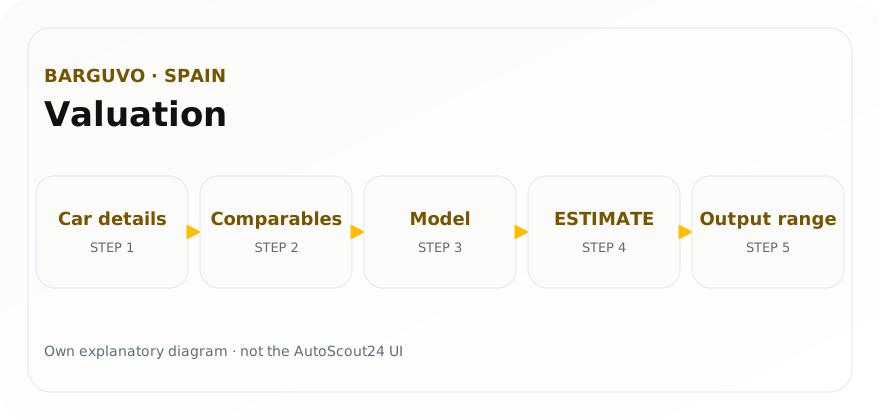
The value of an online valuation is that it quickly answers a practical question: “what price zone could my car be in before I list it?”. AutoScout24 offers a valuation tool within its ecosystem, and its editorial material recommends looking for similar vehicles and getting an estimate based on make, model, mileage, year and other data. Barguvo classifies that result as ESTIMATE because it comes from calculations and comparables, not from an in-person check of each vehicle or from a demonstrated base of closed transactions.
This distinction does not reduce its usefulness. An ESTIMATE can help you spot that your initial expectation is far from the listed market, define a starting range and prepare for a negotiation. What it does not do is prove the exact price you will sell at or certify that two apparently similar cars have the same real value.
In this guide, “valuation” (tasación) means a modelled reference within AutoScout24. An in-person valuation by a professional, a firm purchase offer and the final price of a transaction are different kinds of evidence and must keep their own label.
What data makes two cars comparable
AutoScout24 recommends starting from the vehicle’s data and similar offers. Make and model alone are too broad: version, first registration, mileage, power, fuel, transmission and equipment can materially shift the set of comparables. The more specific the identification, the less likely it is that a basic version will compete in your analysis with one that has a different engine, trim or body style.
Mileage needs context. Two cars with the same figure can have very different maintenance histories. The same goes for age and equipment: a list of extras does not say whether they work or whether they are original. That is why the model should be understood as an approximation based on observable attributes and market data, not as an inspection of the specific vehicle.
Before accepting the result, check that the data entered describes your vehicle. An error in version, power or year can produce an apparently precise figure for a statistically different car.
Comparables: how to use them without counting the same evidence twice
If you already have the valuation tool’s result and then look at similar listings on AutoScout24, avoid treating the two as fully independent sources. The valuation approach itself relies on market context and comparables; looking at the same listings afterwards can reinforce your understanding, but it does not multiply the evidence that a specific SOLD price exists.
Use the manual sample to audit the estimate: are the vehicles really close in version, year, mileage and equipment? Are there listings that are too old, dealers versus private sellers, or damaged cars? Does your vehicle have documentation, maintenance or defects that the filter does not capture? These questions let you interpret the result instead of simply obeying it.
An orderly approach is to keep three columns: the model’s estimate, the ASKING range of current comparables and adjustments specific to your car. The final starting price is decided afterwards, making clear which part comes from each piece of evidence.
Why the real car may differ from the estimate
A model does not see everything an inspection sees. Paint condition, interior wear, tyres, accident history, pending repairs, number and quality of keys, maintenance records, modifications, smell, noise or an active warning light can change the perception and value of a vehicle. Location can also alter demand and logistics, and negotiation introduces a gap between the listed price and the price finally agreed.
That explains why Barguvo does not use “exact” or “guaranteed”, even though a commercial page may use high-confidence language. Aggregate statistical accuracy and accuracy for one specific vehicle are not the same thing.
If an estimate is much higher than comparable offers for genuinely similar vehicles, investigate why before raising the ASKING. If it is much lower, do not conclude that the market is wrong either: review the inputs, version, equipment and how current the comparables are.
Turning the estimate into a defensible starting range
The useful step is not to copy a figure but to build a range. You can take the estimate as an indicative centre, look at the ASKING prices of reasonably close comparables and adjust for the evidence about your vehicle. If you want room to negotiate, add it deliberately instead of inflating the price “just in case”. An excessive margin can reduce enquiries; one that is too narrow can leave you no room to negotiate.
Write the reasoning in a private note: “estimate X”, “comparables Y–Z”, “adjustment for maintenance/defect”, “starting price”. This record will let you review your strategy if no enquiries come in, without retrospectively rewriting why you chose the figure.
When the price changes, record the date. That sequence is your ASKING history, not a history of market sales. Only a closed and documented transaction can move into the SOLD category.
Valuation is not the same as Price evaluation
The two tools may seem similar because both talk about the market, but they answer different questions. The valuation (Tasación) looks from the owner’s side: it tries to indicate what their car could be worth before they decide on the price. Price evaluation (Evaluación de precios) looks at an already defined listing and compares its ASKING with a calculated market price to assign a label such as Súper oferta (Super deal), Buen precio (Good price) or Precio justo (Fair price).
It is best not to merge them editorially. The estimate can exist even if you have not yet published; the label depends on how a specific offer is positioned against the market that AutoScout24 calculates. In addition, a label can change as inventory comes in or is updated.
If you are selling, use the valuation to form your initial reference and Price evaluation to understand how the published offer may be interpreted. If you are buying, do not use either of them as a substitute for CAR-CHECK.
Statistical value does not replace the car’s condition
A high estimate does not prove that the vehicle is in good condition, and a low one does not show that it is faulty. The valuation works with attributes and the market; CAR-CHECK works with evidence about the vehicle itself: identity, documentation, VIN, charges/liens, ITV, mileage, maintenance, inspection and test drive.
This boundary is especially important when a price difference seems “suspicious”. A cheap car may have a legitimate explanation; an expensive one may include exceptional equipment or condition; and any of them may contain incomplete information. Price is a signal that guides questions, not a verdict on fraud or authenticity.
Barguvo can combine both layers in one analysis: first it identifies what the market says, then it lists which facts about the car must confirm or correct that reference. It never reverses the order to make a statistical model certify a physical reality it does not observe.
Common mistakes when using an online valuation
The first is entering approximate data and then trusting the precision of the output. The second is choosing only comparables that confirm the price you already wanted. The third is mixing dealer and private-seller cars without considering that their conditions may differ. The fourth is counting listings as closed sales. And the fifth is ignoring the date: a market can change and an old estimate can lose relevance.
Also avoid multiplying figures without context. Blindly averaging several estimators can give a visually stable figure, but it does not correct anything if they all use similar signals or if your car has a factor outside the model. It is better to document why each reference is comparable.
Finally, do not use the valuation as a “certificate” in a negotiation. You can say that you have consulted a market reference; the buyer will still be entitled to assess the real car and negotiate with their own evidence.
Worked example: a central figure does not remove the range
Imagine the valuation tool returns a reference of around 14.000 €. That figure does not mean the car will sell for 14.000 €. If the genuinely comparable listings are concentrated between 13.500 and 15.000 €, your job is to explain where the vehicle fits: mileage, history, tyres, maintenance, damage and equipment. If there is a costly defect, the reference can still be useful even if your ASKING has to sit below it.
The example also works the other way round. If your car has documented recent maintenance and uncommon equipment, do not automatically turn that difference into a premium equal to the cost of the invoices. The market does not reward every repair or extra euro for euro. Use the evidence to justify a position within the range, not to manufacture a mechanical sum.
When you receive real offers, keep them as negotiation signals for your vehicle. An offer received is not SOLD either; only an executed and documented agreement can be labelled as a closing result.
How to bring the estimate into a negotiation without turning it into an argument from authority
Presenting “AutoScout24 says it is worth X” as an unquestionable truth usually makes the conversation worse. It is stronger to say that you have used a market reference and to explain the facts that justify your price. If the buyer brings better comparables, review them: version, year, mileage, seller, location and condition can make their sample more or less relevant.
Before negotiating, define three private levels: listed price, target zone and the limit you would actually accept. The estimate helps calibrate them, but your time needs and real demand also count. Do not reveal a “minimum” just because a model suggests one.
If weeks go by without useful enquiries, first review the quality of the listing and the comparability before concluding that the valuation tool was wrong. A price can be reasonable and a listing inadequate, or vice versa. Keeping those factors separate avoids fixing the wrong problem.
Freshness: a valuation is a snapshot of the market in time
The reference you get today should not be treated as valid indefinitely. Inventory, demand, the age of the vehicle fleet and the economic context change. If weeks or months have passed since the calculation and you are about to publish or renegotiate, check the market again and keep the date of the result.
The date also helps compare decisions without mixing different moments. An old estimate can still be useful as a history of your strategy, but it does not carry the same weight as a current reference. That is why Barguvo marks freshness alongside the type of evidence: knowing “what” the figure is and “when” it is from avoids a lot of false certainty.
Related guides
These routes divide up the intent so that a single page does not become a mix of publishing, valuation, payment and inspection.
Barguvo can sort comparables and help you interpret an estimate, but it does not generate or certify AutoScout24’s official result, does not turn listings into closed sales and does not carry out an in-person professional valuation.
Organise evidence, price, limits and next steps before acting.
Publishing, payment, contact or handover is completed on the original service.
Official sources and review date
Valuation tool reviewed: 26/08/2026. The tool and its methodology may evolve; Barguvo keeps the output as ESTIMATE and recommends dating each calculation before reusing it.
FAQ
Is the AutoScout24 valuation a sold price?
No. Barguvo classifies it as an ESTIMATE based on the market/comparables, not as proof of a closed transaction.
Can I use it to set my listing price?
Yes, as a reference, combined with current comparables and the condition/documentation of your vehicle.
Is it a certified professional valuation?
It should not be presented as one. It is an online market estimation tool.
Why can the real price change?
Because of condition, defects, history, location, equipment, demand and negotiation, among other factors.
Are the valuation and the price label the same thing?
No. The valuation guides the seller; Price evaluation classifies an ASKING against a calculated market.
Does a low estimate mean the car has problems?
No. It is a signal of modelled value, not a diagnosis of condition.
Does Barguvo generate the official AutoScout24 valuation?
No. It can help you interpret the result, but the official calculation is done on AutoScout24.
Barguvo is an independent assistant and is not affiliated with AutoScout24 or SafeTrade. Reviewed: 26/08/2026.