
What Súper oferta, Buen precio, Precio justo and Sin comparación mean
AutoScout24 uses labels to express how the price of an offer sits against a calculated market price. The first-party methodology presents three positive/comparative labels —Súper oferta (super deal), Buen precio (good price) and Precio justo (fair price)— and a Sin comparación (no comparison) status when there is not enough basis to assign a label. The label summarises relative position; it does not summarise the car’s full history.
“Súper oferta” indicates that the price is well below the calculated market value. “Buen precio” signals a slightly lower position. “Precio justo” is in line with the market value. “Sin comparación” appears when there are not enough comparables or the offer falls outside the conditions that allow it to be modelled. No label is equivalent to “verified car”, “accident-free”, “not a scam” or “recommended purchase”.
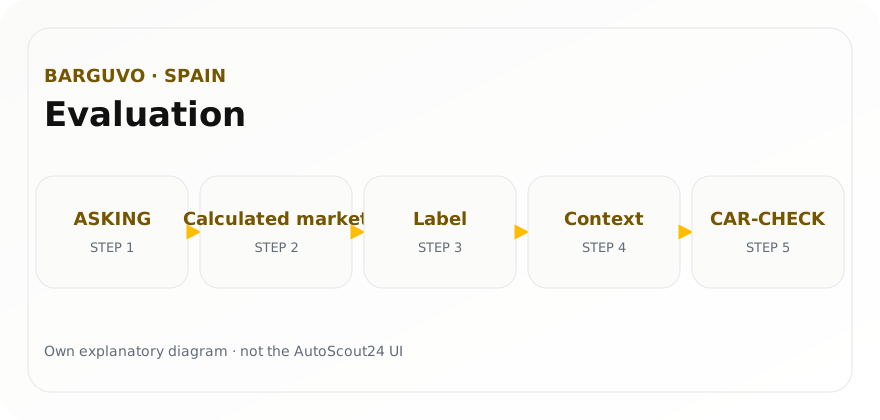
Barguvo keeps the listing’s ASKING as observable data and the label as an interpretation of that ASKING relative to a model. SOLD is left out until there is evidence of a completed transaction.
How AutoScout24 calculates market context
The Price evaluation page explains that each car is compared with similar models available on AutoScout24 or that have been available during the last 14 months. It also says that it excludes prices that are clearly too high or too low and takes into account whether the seller is a dealer or a private individual. According to the current description, the calculation incorporates more than 10 million recorded data points and more than 70 equipment features per vehicle.
These figures help to understand scale, but they should not be turned into “10 million sales”. The source refers to data and comparable offers. Nor does the 14-month window imply that every listing ended in a transaction. The methodology is a market model of listings.
The system generally assumes a state of preservation corresponding to the average of comparable vehicles. That assumption is an important signal: a specific unit may be above or below that average condition, and the label does not inspect it.
Which variables are included and why comparability matters
AutoScout24 lists variables such as previous owners, vehicle type, emissions standard, first registration, body type, warranty, transmission, fuel, consumption, mileage, power, CO2 emissions, number of doors and equipment. The page states that it uses more than 70 features and excludes from the calculation, among others, accident-damaged vehicles and offers with obviously unrealistic prices.
Having many variables does not eliminate all comparability errors. A car may have exceptional maintenance, a poor repair, accessories that are not modelled or an unusual configuration. The quality of the data entered also affects the result: if a listing contains incorrect mileage or wrongly selected equipment, the statistical context can drift away from reality.
That is why the label should be read as an aid to locating an offer within a market, not as a verdict on its final value.
What a label cannot tell you about the car
Even if the model uses many attributes, a label does not replace a physical inspection. It does not prove that the paint is original, that the chassis is undamaged, that the engine is healthy, that the documents are free of charges or that the mileage is genuine. Nor does it show that the seller is reliable simply because the ASKING looks attractive.
A very cheap offer may be due to urgency, location, equipment, condition or a data error. It may also warrant additional questions. The right reaction is to raise the quality of verification, not to conclude automatically “scam” or “bargain”. Likewise, a Precio justo does not turn a mediocre car into a good purchase.
Barguvo uses the label as a price signal. For condition, documentation, VIN, ITV, charges, history and test drive, open CAR-CHECK. Each piece of evidence should answer the question it was created for.
Why the label can change even if the car does not
AutoScout24 explains that the market price can vary as new listings are added and that offers are updated daily within the calculation. This means the same listing can receive a different classification over time without the seller having changed the car. The competitive context moves.
This dynamic is one more reason not to keep an old screenshot as a “permanent truth”. If you are going to negotiate today, check today’s label and comparables. If you are tracking, record the date, ASKING and label to understand the evolution, but keep clear that you are still observing the listings market.
At Barguvo, a change of label can be a trigger to review comparables or the starting price; it does not become evidence of deterioration, fraud or a change in physical condition.
Sin comparación does not mean “bad price” or “worthless car”
The absence of a label has a more limited reading: the model does not have enough suitable comparables or the offer does not fit into a reliable comparison. AutoScout24 mentions rare vehicles, classic cars, listings with little information and clearly extreme prices as examples of situations in which a comparison may be missing.
For a rare car, the absence of a label may be normal. In that scenario, the valuation requires a different sample: specialists, historical documentation, specific condition and truly equivalent comparables. Inventing a zero or assuming that “if it does not compare, it is bad” would be methodologically incorrect.
Barguvo translates Sin comparación as `UNKNOWN/insufficient for this model`, not as `INCONCLUSIVE = fraud`. The lack of statistical evidence is not negative evidence about the vehicle.
Practical difference between Price evaluation and Valuation
If you are a seller and do not yet know what to ask, the Valuation guide (Tasación) is the starting point: it helps interpret an estimated reference for your own unit. If you are already looking at a specific listing and want to know what its badge expresses, this guide is the right one. Price evaluation starts from the published ASKING and positions it against the calculated market.
The two tools may rely on similar signals, so they should not be added together as if they were two independent proofs of a sale. Using them well means understanding the purpose of each. An estimate can help you choose the ASKING; a label can show how that ASKING is positioned afterwards.
The final negotiated price will remain another layer. Only when there is evidence of a completed deal can it be labelled SOLD, and that evidence does not automatically arise from the public tools described here.
How to use the label when buying without lowering your guard
When a label indicates an attractive price, use it to prioritise questions, not to skip checks. Compare version, mileage, seller and equipment with the cars that justify the context. Read the full description, look for inconsistencies and ask for evidence for any material claim. If the price is abnormally low, step up verification of the channel, documentation and vehicle.
SafeTrade can be useful in an eligible private transaction to reduce payment risk, but it does not turn the label into validation of the car either. A protected payment and a competitive price answer different questions.
The final decision should combine price, condition, history, documents, intended use and total cost. A label is a layer of context; not a personal recommendation or a technical certificate.
The label also depends on the quality of the listing data
An algorithm that uses dozens of variables needs reasonable data. If the version, mileage, power or equipment are entered incorrectly, the set of comparables can change. That is why a label should not be read in isolation from the listing: first check that the car is described with enough precision and that there are no visible contradictions between the title, fields and text.
The methodology excludes some extremes and accident-damaged vehicles from the calculation, but that does not mean it detects every error. Incorrectly entered data can still look plausible. Barguvo treats the label as a model output conditioned by its inputs, not as an independent observation of the car.
For tracking, record the label together with the date and ASKING. If it changes without a price change, the market context or the comparison model has probably changed; if it changes after correcting data, part of the difference may come from a better classification of the vehicle.
The same label serves seller and buyer, but with different decisions
For the seller, a label can reveal that the ASKING is well above or below the calculated context and prompt a review of strategy. For the buyer, it can help rank listings that deserve a closer look. In neither case does it replace analysis of the unit.
If your listing receives “Sin comparación”, first try to improve the information if any relevant detail is missing. If the car is genuinely rare, accept that the model has less explanatory power and look for specialised comparables. If it receives “Súper oferta”, check that the price is not low because of an input error before assuming you have found a genuine market anomaly.
The aim is not to chase a particular label, but to use it as feedback. Manipulating fields to obtain a more attractive badge would damage the comparability and trustworthiness of the listing.
The model guides the price question; it does not answer the whole decision
Even a well-calculated comparison is limited to the price dimension. The purchase decision includes the cost of bringing the car up to date, insurance, taxes, travel, financing if any, intended use and repair risk. An attractive ASKING can stop being attractive if the unit needs significant immediate spending.
That is why Barguvo recommends using the label to decide what to investigate next. If the badge looks exceptional, verify the data and condition first. If it looks normal, do not reduce your diligence. The model helps you prioritise; the final decision requires combining price with evidence about the car and total cost.
Four scenarios for reading the badge without turning it into a verdict
Súper oferta with a complete listing: prioritise checking why the ASKING is so far below the calculated context. It may be a legitimate decision by the seller, but the gap justifies reviewing history, documentation and condition more carefully. Buen precio with many comparables: the badge provides useful context, although it still does not answer how much it will cost to bring the unit up to date.
Precio justo on a unit with a visible defect: remember that the general comparison assumes average condition; specific damage can mean the total cost is no longer “fair” for you. Sin comparación on a classic or rare version: the absence of a badge indicates that the statistical engine does not have enough basis, so you need specialists and narrower comparables.
These scenarios show why Barguvo does not translate colours or labels into “buy/do not buy”. The badge changes the list of questions. The decision comes afterwards, when you cross the price signal with technical, administrative and financial evidence about the unit.
Related guides
These routes divide up the intent so that a single page does not become a mix of listing, valuation, payment and inspection.
Barguvo can interpret a label and compare it with other indications, but it does not reproduce the proprietary algorithm, does not turn ASKING into SOLD and does not claim that a car is authentic, safe or mechanically sound because of its price classification.
Organise evidence, price, limits and next steps before acting.
Listing, payment, contact or handover is completed on the original service.
Official sources and review date
Label review: 26/08/2026. The comparables window, variables and classification may change with inventory or the algorithm; AutoScout24’s current listing and explanation prevail.
FAQ
What does “Súper oferta” mean?
That the ASKING is well below the market calculated by AutoScout24; it does not mean the car is verified.
What window does the model use?
The current methodology refers to offers that are available or were available during the last 14 months.
Are these 10 million completed sales?
No. The page refers to more than 10 million recorded data points, not 10 million SOLD transactions.
What does “Sin comparación” mean?
That there is not enough suitable basis for comparison; it does not mean zero value or fraud.
Can the label change?
Yes. AutoScout24 states that inventory changes and updates can modify the calculated market price.
Are Valuation and the label the same tool?
No. Valuation (Tasación) gives guidance on an estimated value; the label classifies a specific ASKING against a calculated market.
Does a good badge replace CAR-CHECK?
No. CAR-CHECK remains the owner of physical condition, documentation, VIN, charges, ITV and history.
Barguvo is an independent assistant and is not affiliated with AutoScout24 or SafeTrade. Review: 26/08/2026.