
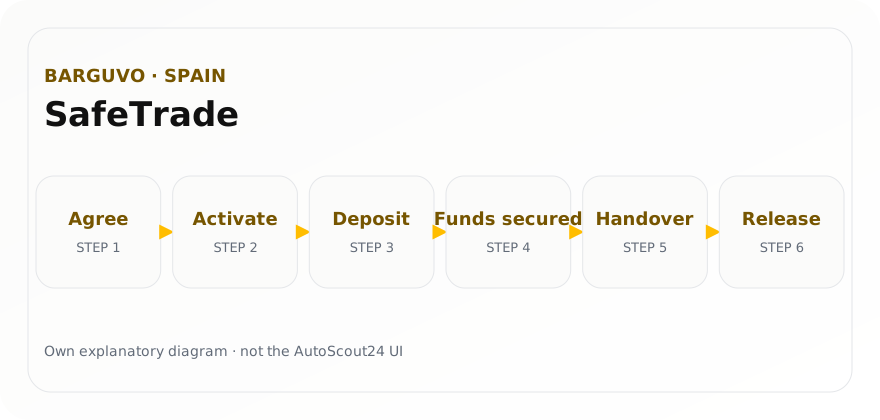
What SafeTrade is and who can use it
SafeTrade is the payment layer that AutoScout24 currently offers for second-hand car transactions between private individuals. The first-party page specifies that the car must be listed by a private seller on AutoScout24 and that it is not available for new cars or for sales of business vehicles at this time. Both buyer and seller must be residents of a country in the European Union or the European Economic Area. In addition, the availability note lists Spain among the current markets.
This means that “I have a listing on AutoScout24” is not enough to assume eligibility. The type of vehicle, the status of the parties and the specific flow all matter. Nor should SafeTrade be extrapolated to motorcycles: the Spanish page describes used cars between private individuals and R91 has not found equivalent first-party support for motorbikes.
Barguvo treats it as a mechanism specialised in reducing payment risk, not as a universal guarantee of the sale. Inspection, administrative status, ownership, charges and mechanical condition remain outside its main function and must be verified with the appropriate sources and owners.
The six-step flow: agreement, activation, deposit, handover and release
The process published by SafeTrade begins when buyer and seller agree on the car, the price and the use of SafeTrade. The seller starts the transaction from their AutoScout24 listing; the buyer then receives an official invitation to join the flow. The buyer makes the payment into the protected account and the seller waits until the funds appear as secured before handing over the vehicle.
Handover does not automatically release the money simply because the car has been moved. The current description requires confirmation of handover and presents the release as happening after the parties confirm. That is why the timeline must be visible to both and must not be replaced by screenshots sent through external messaging or pages imitating the service.
Nor does SafeTrade become a chat channel. The FAQ itself states that buyer and seller continue to communicate directly, although they can upload photos and documents that are important for the transaction. The service manages the payment process, not the whole commercial relationship.
Fee: 0,5 % with a 10 € minimum and a 100 € maximum
The current fee is expressed as a clear formula: 0,5 % of the final sale price, with a minimum fee of 10 € and a maximum of 100 €. By default the buyer pays, but the seller can take it on or split it during the negotiation. This makes it possible to calculate mathematical examples without presenting them as Barguvo “special prices”: a sale of 5.000 € would give 25 €; one of 1.000 € would be subject to the 10 € minimum; a sufficiently large transaction is capped at the 100 € maximum.
The fee belongs to SafeTrade, not to the basic AutoScout24 listing. That is why the old idea that “AutoScout24 does not charge a fee” needs to be qualified: publishing the basic listing may still be free while a transaction using this payment layer generates a specific fee. They are different products.
Before closing a deal, check the amount shown by the real SafeTrade Portal. The published formula is dynamic and must be revalidated if AutoScout24/PayProff changes the conditions.
When the money moves and why “instant” would be an incorrect promise
SafeTrade states that timings depend on the bank. A transfer may arrive in seconds or take up to three working days; large amounts may trigger additional checks and lengthen processing. This warning applies to the buyer’s deposit, to a possible refund after cancellation and to the final payment to the seller.
Therefore “funds secured” and “money already available in the seller’s account” are different states. The seller must follow the status within the official channel and not hand over the car because someone shows a screenshot or says the transfer is on its way. The buyer, for their part, should not interpret the deposit as a transfer of ownership of the car: the handover and the confirmations in the flow are still to come.
If there is a journey or an appointment, leave margin for these timings and for bank checks. SafeTrade can reduce payment uncertainty; it does not remove the need to coordinate dates, documentation and handover precisely.
Cancellation and dispute: funds held does not mean arbitration
If the transaction is cancelled, the current page states that the buyer’s payment is refunded. A dispute is different. SafeTrade keeps the money held until both parties confirm the handover, but it expressly states that it does not intervene to resolve disputes. Buyer and seller must try to resolve the situation directly; if they cannot reach an agreement, the FAQ describes the need for a legally binding court order to decide how to release or refund the funds.
This limitation is central because it prevents “security” marketing from being turned into protection the product does not promise. SafeTrade does not decide who is right about a defect, does not inspect the car, does not authenticate documentation and does not guarantee a favourable outcome if a conflict arises.
Barguvo can help you build a timeline, separate facts from allegations and review what evidence is missing, but it does not arbitrate or control the funds. In a real dispute, keep communications, documents and SafeTrade Portal statuses and look for the appropriate route for the case.
Cross-border transactions and EU/EEA residence
SafeTrade publishes support for cross-border transactions and explains that the buyer can deposit the money before travelling, while the seller sees that the funds are secured before reserving the car. That design can help when the parties are in different countries, but it does not turn an international purchase into an administratively simple transaction.
The current residence requirement is EU/EEA for both buyer and seller. In addition, availability of the SafeTrade marketplace is limited to certain AutoScout24 countries, including Spain. A cross-border transaction may add registration, export/import, taxes, documentation and temporary insurance; those matters are not resolved automatically by using SafeTrade.
Barguvo therefore separates two layers: compatible cross-border payment within the published scope, and the vehicle’s administrative compliance. For the second layer, consult CAR-CHECK and the competent authorities, not the “paid” status in the portal.
Official domain, invitation and anti-phishing signals
SafeTrade’s own page includes a specific fraud warning: the official domain is safetrade.autoscout24.com and official emails are sent from the address published on the page. Any other website, email or payment instruction claiming to be SafeTrade should be treated as suspicious until verified.
The practical defence is not to follow a link just because it includes a logo or a convincing screenshot. Go in from the listing and official channels, check the full domain, avoid transferring money to accounts shared by chat and confirm the status within the SafeTrade Portal. The existence of a real product is precisely what creates a useful vector for imitations.
Barguvo will not ask you to transfer funds, does not generate deposit accounts and does not replace the portal. If something does not add up, stop the transaction before handing over the car or sending more money.
Who operates the payment infrastructure
The Spanish page attributes the regulated infrastructure to PayProff A/S, a Danish payment institution authorised by the Danish Financial Supervisory Authority. It also explains that PayProff acts as an independent party in the transaction. This attribution matters because it avoids saying imprecisely that “AutoScout24 holds your money” or that Barguvo takes part in safekeeping the funds.
For the user, the editorial consequence is simple: use the name of the product and of the provider as they appear in the current terms, and do not extrapolate financial protection to aspects the system does not cover. The provider’s identity, licence and rules can change; that is why they are P0 freshness data in every update.
The aim of this guide is not to assess PayProff’s regulatory solvency, but to describe correctly which part of the flow SafeTrade manages and what remains outside it: inspection, ownership, condition, substantive negotiation and dispute resolution.
Identity, data and payment checks: what to expect without treating them as an endorsement
SafeTrade explains that it collects the information needed to verify identity, complete the transaction and comply with anti-money-laundering obligations. That verification is part of the payment process, but it should not be interpreted as a personal recommendation of the buyer or seller or as a guarantee about the car. KYC and identity answer a different question from mechanical condition, effective ownership or performance of the contract.
Additional bank checks may appear in high-value transactions. This fits with the warning that transfer times may be longer. If a request for data appears outside the portal, compare it with the official flow before acting. The existence of legitimate checks does not make every unexpected request genuine.
Minimise the information you send through parallel channels. A party may need documents for the transaction, but there is no reason to forward full copies of identification to a dubious domain or to a messaging account presenting itself as support. When the platform needs data, enter it within the official portal and keep evidence of the transaction status.
Handover checklist: secured payment does not mean “handover without checks”
Before handing over the vehicle, verify within the SafeTrade Portal that the status corresponds to secured funds and that the transaction is the right one. Do not use a screenshot from the buyer as a substitute. Also check that the car, price and parties match what was agreed and prepare a timeline of keys, documentation and handover confirmation.
During the handover, the parties must distinguish three milestones: the money is deposited, the car is handed over and the handover is confirmed. Mixing them up can create conflicts over when the payment should have been released. If something material changes —for example a defect is discovered or there is a discrepancy in the documentation—, stop the sequence and resolve it before confirming a fact that no longer reflects the agreement.
After confirmation, keep the portal’s receipt and wait for the actual bank processing. If the payment takes a while to arrive, check the official status and the published timeframes before assuming the money has been lost. Barguvo can help you organise the milestones, but it does not see or control the SafeTrade account.
Related guides
These routes divide up the intent so as not to turn a single page into a mix of listing, valuation, payment and inspection.
Barguvo can explain the flow, calculate the fee and organise evidence, but it does not activate SafeTrade, does not hold or release funds, does not refund payments, does not arbitrate disputes and does not certify the vehicle. Every monetary action continues in the official SafeTrade Portal.
Organise evidence, price, limits and next steps before acting.
Publishing, payment, contact or handover is completed on the original service.
Official sources and review date
SafeTrade review: 26/08/2026. Fee, eligibility, EU/EEA residence, timings, refund, provider and dispute handling are dynamic P0 data; the official SafeTrade Portal takes precedence.
FAQ
How much does SafeTrade cost?
It currently charges 0,5 % of the final price, with a minimum of 10 € and a maximum of 100 €.
Who pays the fee?
By default the buyer; the seller can take it on or split it during the negotiation.
Can I use SafeTrade for a motorbike?
R91 does not claim so. The current Spanish source documents used cars between private individuals, not motorcycles.
Does it work between countries?
Yes, within the published scope: buyer and seller must be EU/EEA residents and the service supports cross-border transactions.
Does SafeTrade decide who is right in a dispute?
No. The page expressly says it does not mediate disputes; the parties must resolve them and, without agreement, a court route is described.
When does the seller receive the money?
After the handover confirmations described; bank processing can take up to 3 working days.
Does SafeTrade verify mechanical condition or charges?
No. For the car’s physical/administrative reality, Barguvo keeps CAR-CHECK as the owner.
Barguvo is an independent assistant and is not affiliated with AutoScout24 or SafeTrade. Review: 26/08/2026.