
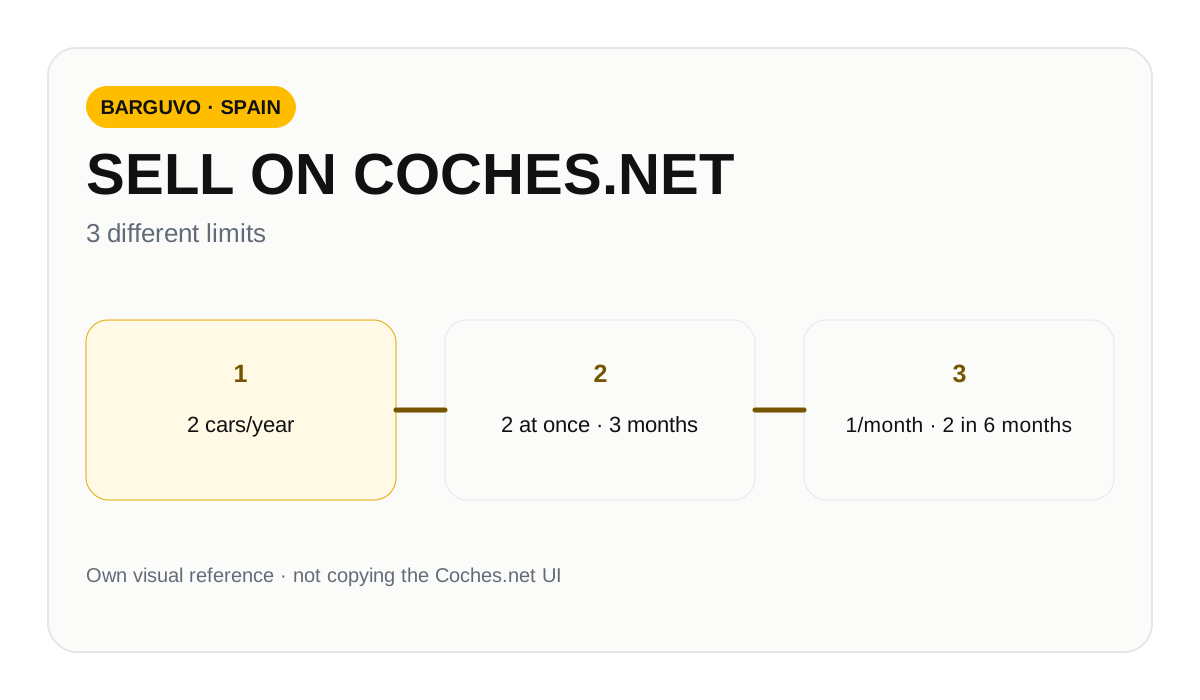
Coches.net’s three limits do not mean the same thing
Coches.net has several rules that can seem contradictory if read out of context. The private seller help says that, if you sell up to a maximum of two cars a year, you can list as a private seller. Another help page allows you to have up to two free listings published at the same time, each valid for three months. And the terms of service add a cadence of one free listing per month per user up to a maximum of two listings in six months.
Refers to the maximum number of cars sold to list as a private seller according to the specific help page.
Up to two free listings active at the same time; each listing is valid for three months.
Up to a maximum of two free listings in six months according to the terms.
Do not use the phrase “Coches.net allows two listings” without saying which dimension you are explaining. If you delete a listing, the help states that three months must have passed since it was first posted before you can publish another one for free.
Prepare the car and the evidence before writing
Before the copy, gather the technical data sheet, current mileage, version, fuel, gearbox, power, registration plate where appropriate, available maintenance history, number of keys, extras and relevant defects. The description must match the actual vehicle, not an ideal version of the model.
The photographs must be yours or properly authorised. Show the exterior, interior, dashboard, tyres, boot, keys and relevant damage. Barguvo’s rule on AI editing remains locked: it may improve exposure or framing, but never erase dents, scratches, wear, warning lights, number plates when they are part of the necessary evidence, components or colour changes that alter the perception of the vehicle.
Reconocimiento de Imagen (image recognition): use it as an aid, not as an authority
Coches.net has an image recognition feature that can automatically fill in data such as make, model, year, colour and body type from a photo. It is a data-entry convenience, not documentary proof. Check each field against the technical data sheet and the actual car before publishing.
An automatic prediction can get trims, generations or colours wrong. If the technical data sheet and the visual inference differ, the documentation and your own verification prevail, not the automatic suggestion.
Opening price: ASKING is not SOLD
The amount you write in the listing is ASKING: your asking price. It can be informed by comparables and an estimate, but it does not prove what transactions are actually closing at. Barguvo keeps ASKING separate from SOLD, ESTIMATE, BARGUVO_ESTIMATE and PROFESSIONAL_APPRAISAL.
Set a defensible price based on version, year, mileage, condition, extras and location. If you use the Coches.net valuation tool, treat it as an approximate reference; the valuation guide explains why it should not be turned into a supposed history of closed sales.
Anuncio Top and Venta rápida are visibility services, not a guarantee of sale
The official help revalidated today still shows Anuncio Top for 24,99 €, sharing the top five positions for 30 days, and Venta rápida for 24,99 €, which bumps the listing up twice a day for 10 days. These are dynamic commercial data and may change.
Paying for visibility does not prove that the car will sell sooner, or that it will reach a specific price. Weigh the cost against the margin you expect, how long the listing has been live and the quality of the listing. Barguvo does not invent conversion rates or success percentages.
What to check before publishing
Check that the visible price is the final price you are really asking; that the car’s information is consistent; that you are not hiding contact details in photos or text; and that the images do not belong to third parties without authorisation. Publication is subject to Coches.net’s rules and validations.
If your goal changes from “publishing” to “checking whether the car is safe to buy”, leave this guide: the right owner is CAR-CHECK, which covers DGT, VIN, ITV, mileage, charges, test drive and inspection.
Barguvo listing checklist
- I have distinguished user type, simultaneous capacity and cadence.
- The version and mileage match the documentation.
- The photos show condition and defects without misrepresenting them.
- The price is treated as ASKING, not SOLD.
- I have verified any data suggested by image recognition.
- If I buy visibility, I know its current cost and do not interpret it as a guarantee.
- The final publication is done on Coches.net.
Registration and validation: a listing is not finished when you press “publish”
The current terms place free publication for private sellers behind an account and phone number validation. That validation is free, is required for the first listing and, if it is not completed within the period described by Coches.net, the listing may disappear from the management area. It is a simple operational detail, but it explains why a correctly completed form does not yet equal a visible listing.
Before you start, use an email address you control and a real phone number. Do not try to multiply accounts, emails or phones to get around the limits: the rules themselves prohibit duplicate listings that exceed the limits even if different contact details are used. For Barguvo, that kind of shortcut is not an optimisation; it is a way of creating inconsistencies and increasing the likelihood of rejection.
It is also worth keeping contact details separate from the description. Coches.net already has contact fields and areas; its rules do not allow you to insert a phone number or email in the listing text or embed them in photos or videos. If you only want to be contacted by phone, you can say so in the text without repeating the number. The listing and the official channel should keep the contact information in the intended place.
Think of publication as a sequence: valid account → vehicle data → compliant content → validation → Coches.net review → active listing. Barguvo can help you review the earlier steps, but it cannot confirm that the platform has approved the listing until Coches.net shows it as published.
Quality rules that change how you should write the listing
Coches.net’s terms are quite specific: repeated listings are not allowed, the mileage must be real, colour/model/version must match the photograph, only one vehicle may appear per listing and the main price must be the full final price. That rules out tactics such as entering “1 €”, using a fictitious price to attract clicks or mixing two cars in the same listing.
Nor is the title a free advertising slogan. The current rules state that it must correspond to the make and model and restrict promotional formulas or misleading titles. For the reader, this has an advantage: the description is where you can provide real context —maintenance, use, equipment, defects, reason for selling or accessories— without turning the title into a string of adjectives.
For photos, the rules reject material that does not match the vehicle, watermarks from other portals, embedded contact details and various kinds of retouching. That fits Barguvo’s photo contract: a lighting improvement or a framing correction is only acceptable if it does not misrepresent condition, identity, colour or components. If the edited image is no longer a reliable representation of the car the buyer will see, it should not be used.
A good listing does not need to look perfect. It needs to be consistent. A dent that is shown and explained may reduce visual appeal, but it increases the buyer’s ability to decide with real information and avoids a viewing starting with a discrepancy you already knew about.
A useful description: what to add after the automatic fields
The structured fields already capture much of the technical data sheet, so the text should provide what those fields do not explain well. A practical approach is to organise it into four blocks: usage history, documented maintenance, current condition and included items. There is no need to turn the listing into a dossier, but you should cover the questions a reasonable buyer would have before travelling to see the car.
In the usage history, avoid claims you cannot prove. “Always garaged” or “never had an accident” are strong statements; use them only if you have grounds to back them up. In maintenance, distinguish an available invoice from a claim made from memory. In condition, separate normal wear from specific damage. And in included items, list the keys, sets of wheels, chargers, cables, accessories or documents you are actually handing over.
A good text also reduces noise in the negotiation. If you have already explained that there is a scuff on the bumper, that the front tyres will soon need replacing or that a second key is missing, an interested party does not need to discover it at the end. That does not mean making a mechanical diagnosis: when the question becomes technical, the right owner is still CAR-CHECK.
Avoid copying the full text of another listing. As well as the problems with rights and the platform’s rules, it usually introduces data from another vehicle. Barguvo can help you rewrite from your facts; it should not generate a description that invents history, equipment or condition to make it “more sellable”.
Photo plan: show enough without turning the gallery into advertising
Start with a clear exterior photo in which the car fills most of the frame. Continue with the sides, front, rear, interior, dashboard, seats, boot, wheels/tyres and specific details. If there is relevant damage, it deserves its own photograph. The aim is not to hide the defect within a general shot, but to let the interested party understand its size and location.
Avoid people, visible private data and any third-party material you do not have the right to publish. Coches.net’s current terms also reject photos with URLs, phone numbers, emails and watermarks from other portals. If you reuse your own images across services, keep the clean original rather than downloading the watermarked version from another marketplace.
With AI, apply the evidence criterion: correcting exposure can help; replacing a background can be problematic if it removes shadows or references that alter perception; removing a number plate for privacy may be reasonable in an editorial piece, but it must not hide a documentary discrepancy; and erasing dents, stains, warning lights or wear is directly incompatible with the Barguvo contract.
Before uploading, compare the photos with the automatic fields. If image recognition suggests a different version, colour or body type, do not pick the “most likely” option without verifying it. In a car, a different trim or engine variant can change both the price and the buyer’s expectations.
Messages, calls and negotiation: prepare the conversation without losing control of it
Once the listing is live, the same questions will come up again and again: availability, maintenance, last ITV, reason for selling, defects, possibility of a test drive and price flexibility. You can prepare answers before you receive them. That reduces improvisation and prevents two interested parties from receiving incompatible versions of the same story.
Do not confuse speed with blind automation. Barguvo can suggest a reply, but it must not impersonate you or send messages automatically without an authorised integration and an explicit flow. In a vehicle sale, a misinterpreted sentence about warranty, condition or price can have significant consequences.
Also define your negotiating zone. The published price is ASKING; your minimum may be different. Decide in advance which facts justify an adjustment —for example, a pending repair that is already documented— and which arguments do not change your valuation. If an offer depends on a technical inspection, say so as a condition rather than treating the first figure as a closed agreement.
When an interested party wants to move forward, steer the decision towards documentation, identity and a real check. There is no need to duplicate the technical protocol here: CAR-CHECK exists precisely for that jump from “listing” to “vehicle I am going to buy or sell”.
When it makes sense to pay for visibility and when to fix the listing first
Visibility products can increase exposure, but the order of decisions matters. If the listing has the wrong version, poor photos, a price clearly out of line with comparables or an empty description, paying to show it more often only amplifies the problem. Fix the listing first; then decide whether it deserves promotion.
Use a simple test: identify which hypothesis you are trying to resolve. If you get views but no conversations, perhaps the problem is not position. If you barely appear in relevant results despite a correct listing, visibility may make more sense. If there are messages but they all end with the same objection, analyse that objection before buying another package.
Do not invent ROI. Without your real data you cannot claim that 24,99 € “pays for itself” or that the car “will sell X days sooner”. Record the activation date, number of useful contacts, viewings and outcome. That data of your own does allow you to assess your case, even though it is not a general Coches.net statistic.
And remember that Top and Venta rápida are different products: one shares top positions for a period; the other bumps the listing up over fewer days. Choose by objective, not by the commercial name. Their prices and mechanics are dynamic, so they must be checked on Coches.net at the time of purchase.
Edge cases worth resolving before publishing
Foreign registration plate: the rules allow for vehicles without a Spanish registration plate, but require you to state that they have the relevant permits for use in Spain. Do not use that possibility as a substitute for checking the administrative status. Car reserved or sold: a listing that is no longer available should not remain active; if it is temporarily reserved, manage its availability using the platform’s options.
Financed price: do not turn a monthly instalment or a conditional discount into the main price if it does not comply with the rules for that field. The visible price must be consistent with the listing conditions. Several vehicles: a listing cannot serve as a catalogue of several units. Duplicates: publishing the same car from different accounts or provinces does not make the duplicate valid.
Car with major defects: describing them does not allow you to skip legal or documentary requirements. Old photos: if the condition has changed since you took the pictures, update them. Wrong automatic recognition: correct the suggestion before publishing; the convenience of autocomplete does not shift your responsibility for the data.
These cases are useful because they show the difference between “filling in a form” and “publishing a defensible listing”. Barguvo’s goal is to help you with the latter.
From listing to sale: where this guide ends
This page ends when the listing is prepared, published and starts generating conversations. From there, tasks appear that have different owners: valuing the car to put the price in context, comparing with a direct sale to a professional, reviewing a possible Reserva Online for a dealer car or technically checking a vehicle with CAR-CHECK.
Separating those steps avoids a common mistake in SEO content: turning a single “mega-guide” into a text that repeats everything and ends up out of date on several pages. The listing and presentation rules live here; the estimated price lives in TASACIÓN (valuation); the dealer flow in VENDER A PROFESIONAL (selling to a professional); and inspection/administration in CAR-CHECK.
If the limits, visibility prices or quality rules change, this guide must be updated from the official sources. If your car’s condition changes, so must the listing. Freshness of policy and freshness of evidence are two different obligations.
When both are aligned, you can move on to publishing with a listing that explains what you are selling, shows what exists and makes clear what price you are asking.
Before closing the screen, do one last read as if you were the buyer: could you identify the exact vehicle, understand its condition, know what is included and distinguish the real price from any promotion? If an answer depends on assumptions, a correction is still missing. This final read often detects inconsistencies that do not show up when reviewing field by field.
After publishing: measure, update and withdraw in time
A listing should not stay frozen for months while the car changes. Record the publication date, the initial mileage and any relevant change in condition. If you make a long trip, repair a wing, change tyres or a warning light comes on, review the listing and the photos. The accuracy of the listing is an ongoing condition, not a one-day check.
You can also measure the response without inventing market metrics. Count useful conversations, viewing requests, serious offers and repeated objections. A week with many messages asking the same thing may reveal a gap in the description. Several viewings that end when the buyer sees a defect that was not properly explained indicate that you need to improve the evidence. These are data from your own process, not Coches.net statistics.
If you change the price, keep a history of your changes. That way you can distinguish “the market is not responding” from “I have changed strategy three times without waiting for enough information”. The same principle applies to visibility products: note when you activated them and what signals appeared afterwards. Correlation is not causation, but a record is more useful than an impression.
When the car is sold, reserved in a way that makes it no longer available, or you decide to withdraw it, update the listing. Coches.net’s rules do not allow sold, reserved or unavailable vehicles to be kept up in a way that confuses people looking for a vehicle. Keeping an old listing active to “collect contacts” defeats the purpose of the listing.
Finally, keep your documentation for the transaction outside the listing: contract, receipts, relevant communications and any applicable proofs. Barguvo can help you organise a checklist, but it does not replace the original documents or the formalities the specific transaction requires.
If the platform changes a rule after you have published, review the listing in the current context: do not assume that an old condition will still apply in the same way to a renewal, visibility upgrade or new listing. The aim is for the listing to remain correct both for the car and for the service hosting it. That discipline also makes it easier to answer interested parties with a consistent version of the facts, without relying on different recollections in each conversation or on information that is already out of date.
Related guides
Topics are divided among owners to avoid duplicating rules or presenting an estimate as if it were evidence of a closed sale.
Barguvo can help you prepare the listing, cross-check the price and review the evidence, but it does not post or renew listings on Coches.net, does not contact interested parties and does not complete the sale. The form and any commercial action continue on Coches.net.
Review evidence, price, cost and risks before acting.
Publishing, valuation, contact, reservation or the sale itself is completed on the original service.
FAQ
How many cars can I sell as a private seller on Coches.net?
The specific help states up to a maximum of 2 cars sold per year to list as a private seller.
Can I have two free listings at the same time?
Yes. The current help states up to 2 simultaneous free listings, each valid for 3 months.
So can I publish two listings on any day?
It is best not to summarise it that way: the terms add 1 free listing per month per user up to a maximum of 2 in 6 months.
How much does Anuncio Top cost?
The help revalidated on 25/08/2026 shows 24,99 € for 30 days, sharing the top five positions.
How much does Venta rápida cost?
The revalidated help shows 24,99 €, with two bumps a day for 10 days.
Does image recognition always identify the car correctly?
It should not be treated as proof. Check the suggested fields against the documentation and the actual vehicle.
Does Barguvo publish the car for me?
No. Barguvo prepares and reviews; publication is done on Coches.net.
Revalidation: 25/08/2026. The limits and visibility prices are dynamic data and must be checked again if Coches.net changes its terms or products.