
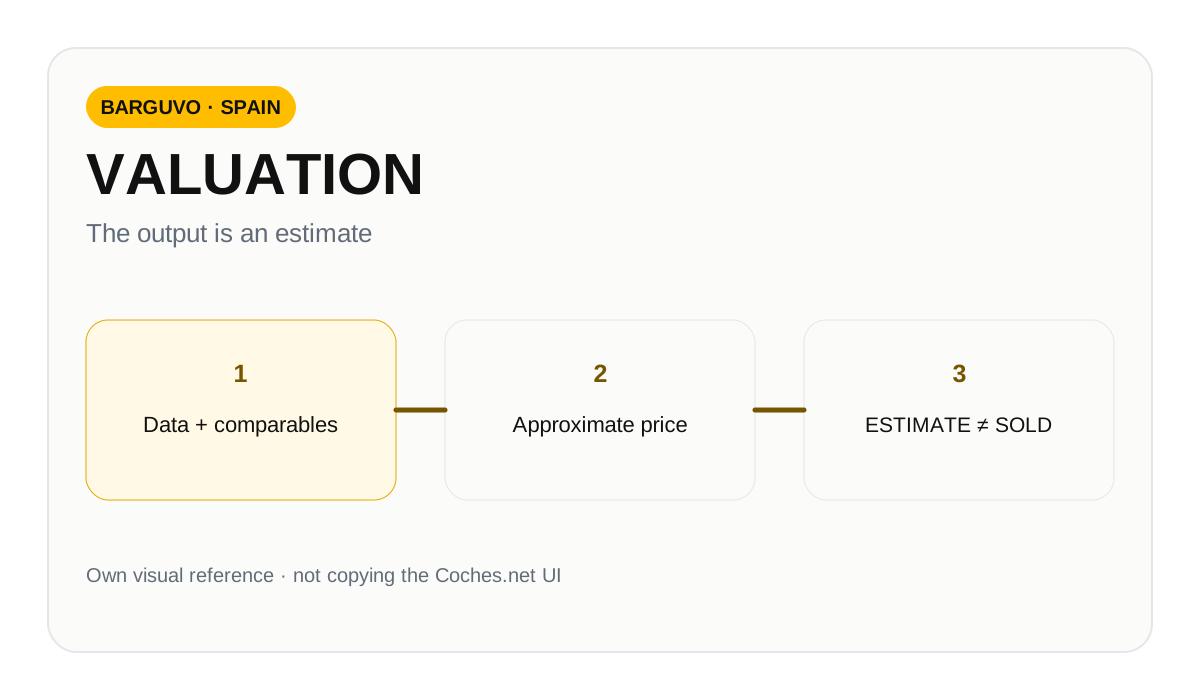
What the Coches.net valuation really means
The official help says that, if you know the car’s technical data, special features and condition, you can use the service to get an idea of the approximate selling price. That wording matters: it is an estimate, not a certification or a guaranteed price.
The product can be a good starting reference for deciding on an ASKING price, comparing a professional offer or spotting an expectation that is clearly out of range. But Barguvo does not turn that figure into a supposed closed transaction.
What information can move the estimate
Year, version, fuel, gearbox, mileage, body type, equipment and condition all affect value. Some extras, damage, history, maintenance, number of owners or local demand may not be captured with the same precision by an automatic tool.
That is why two cars that are “identical” on paper can justify different prices. If a relevant piece of data is missing, uncertainty increases and must be reflected in the decision, not hidden behind a single figure.
Comparables: useful, but not automatically closed sales
Coches.net explains that it compares vehicles with similar characteristics in its valuation tools. Without a first-party source showing that the set used consists exclusively of closed sales, Barguvo keeps a strict separation: observed listings are ASKING and the calculated output is ESTIMATE.
This avoids the most dangerous mistake: building a false SOLD history from published prices. If verifiable evidence of closed transactions appears in the future, it will be labelled separately.
How to use an estimate without turning it into an order
Start with the estimate and create a reasonable range. Then adjust for actual condition, maintenance, tyres, damage, extras, location and urgency. If you are selling, set an opening price and a minimum. If you are buying, use the figure as one more signal within the negotiation.
Do not use a decimal or a precise figure as false precision. An automatic tool can give better guidance when the input data is good, but it does not necessarily see everything a physical inspection would.
Automatic valuation and professional offer are different evidence
In the route for selling to a dealer, Coches.net distinguishes the initial reference from the final price a professional proposes after checking condition and extras. Barguvo keeps that separation: the automatic valuation is ESTIMATE; the professional’s offer is PROFESSIONAL_APPRAISAL/OFFER.
The fact that a professional offer is binding in its context does not make it a “universal market price”. It is the decision of a specific professional buyer under their own conditions.
The condition that changes the price also belongs to CAR-CHECK
If the question is no longer “what price reference do I have” but “what is the actual condition of this vehicle”, use CAR-CHECK. That is where inspection, DGT, VIN, ITV, mileage, charges, test drive and technical history live. This guide is limited to what the valuation means and does not duplicate that checklist.
A good estimate built on bad data is still a bad basis for a decision. First verify the facts that feed into the value.
Checklist for interpreting a valuation
- I have checked the version, year and mileage.
- I have described the actual condition without hiding damage.
- I treat the output as an ESTIMATE.
- I do not call prices from comparable listings SOLD.
- I keep a professional offer separate from an automatic estimate.
- If the condition is uncertain, I move on to CAR-CHECK.
Think in terms of range and confidence, not just one figure
An automatic estimate is usually presented as an easy-to-read number, but your decision should add a level of confidence. If the version is perfectly identified, the mileage is recent and the condition is well documented, the reference can be more useful than when data is missing or there are significant modifications.
Barguvo can turn a figure into a working range without claiming that this range is “the real price”. The range helps you think through scenarios: what you would ask if you are in no hurry, what minimum you would consider and at what point a professional offer deserves a second look. Uncertainty is information, not a defect to be hidden.
When two sources differ, do not take an automatic average. First ask whether they measure the same thing. An active listing is ASKING; a valuation tool is ESTIMATE; a dealer offer is PROFESSIONAL_APPRAISAL/OFFER. Mixing them without labels creates an apparently precise figure out of evidence with different meanings.
Hypothetical example: three figures that should not be turned into one
Imagine a vehicle for which the valuation tool gives a reference of 15.000 €, you see comparable listings between 15.500 € and 17.000 € and a professional offers you 13.800 € after inspecting the car. These amounts are purely a teaching example; they do not come from a real transaction.
The correct reading would be: 15.000 € = ESTIMATE from a tool; 15.500–17.000 € = ASKING from observed listings; 13.800 € = PROFESSIONAL_APPRAISAL/OFFER. You still do not have a verifiable SOLD. From there you can decide whether the time and effort of finding a private buyer justifies keeping a higher ASKING or whether you prefer the relative certainty of a professional offer.
The mistake would be to write “the car is worth 15.800 €” because it is the average of the three sources. That mathematical operation hides the fact that each figure answers a different question.
What to do when the car changes after the valuation
A valuation has an implicit date. If you add kilometres, a fault appears, you repair damage, change tyres or add relevant documentation, the previous reference loses part of its value. Recalculate or, at the very least, adjust your confidence in the old figure.
The same happens with the market. A comparable published months ago does not necessarily describe the current situation. You do not need to invent an “index” to recognise this: simply record the date of each piece of evidence and give more weight to whatever is comparable and recent.
If the change affects the mechanical or administrative condition, do not try to solve it with price alone. First verify the fact through CAR-CHECK and then value the car again. A discount does not turn a technical uncertainty into a check.
Using the valuation in a negotiation without presenting it as absolute authority
As a seller, you can use the reference to justify how you built your price, but avoid “Coches.net says it is worth exactly X”. As a buyer, you can use it to spot a difference and ask why that vehicle is above or below it. In both cases, the conversation improves if it focuses on facts: mileage, version, condition, maintenance and extras.
An estimate does not on its own invalidate a different price. An exceptional vehicle can justify a premium; a damaged vehicle may fall below it. The tool provides context, not a verdict.
Before negotiating, define what evidence would make you change your mind. That stops you from moving the price under pressure without understanding the reason. Barguvo can help you prepare that threshold, but it must not invent comparables or sales to strengthen a position.
The same estimate answers different questions when selling and when buying
As a seller, the question is usually “what opening price makes sense?”. There the estimate can work as an initial anchor, but you must add negotiating margin, actual condition and your priorities. An ASKING higher than the estimate is not automatically wrong; it needs a defensible explanation. A much lower ASKING is not automatically a bargain either: it may reflect defects or urgency.
As a buyer, the question changes: “what would have to justify this price?”. Use the reference to prepare questions, not to accuse the seller of being wrong. If the vehicle has fewer kilometres, a rare version, a full history or valuable equipment, it may move away from the reference. The same applies if it has damage, pending maintenance or documentary uncertainty.
In both directions, an estimate is more useful when you turn it into verifiable hypotheses. Instead of “it is worth 15.000”, think “my reference is around this level if the version, mileage and condition are what I believe”. Each confirmed fact raises or lowers your confidence. That language prevents an automatic figure from acquiring an authority the source does not promise.
If a professional offer appears later, do not mechanically average it with the valuation tool. Compare it as different evidence. If you later obtain a genuinely sold price with verifiable proof, then you can add a separate SOLD category. Barguvo keeps that typed history precisely so that a new figure does not rewrite the meaning of the previous ones.
Also record the date. An estimate from today and a comparable listing from months ago are not equally fresh. Dating each piece of evidence lets you update only the part that is ageing, instead of redoing the whole valuation from scratch or keeping an old figure out of convenience.
Finally, avoid presenting a valuation figure without a time context and without describing the vehicle. A useful reference should always answer three questions: which car was valued, with what data and on what date. If any of these is missing, lower your confidence before using it in a decision or negotiation. And if two consecutive valuations change a lot, first review the data entered and the date before interpreting the difference as a real market movement. A discrepancy in the input can on its own explain a different output, especially if the version, mileage, declared condition or equipment changes.
Related guides
Topics are divided among owners to avoid duplicating rules or presenting an estimate as if it were evidence of a closed sale.
Barguvo can help you interpret an estimate and separate ASKING, SOLD, ESTIMATE and professional offer, but it does not turn references into closed sales or run the Coches.net valuation. The original tool and its data remain with the original service.
Review evidence, price, cost and risks before acting.
Publishing, valuation, contact, reservation or the sale itself is completed on the original service.
FAQ
Does the Coches.net valuation tool show prices that were actually sold?
The revalidated help presents it as an idea of the approximate selling price. Barguvo does not treat it as SOLD without explicit evidence of closed transactions.
Can I use the valuation as my listing price?
You can use it as a reference to set your ASKING price, adjusting for condition, extras, location and goals.
Is it a certified professional valuation?
It should not be presented that way. It is an automatic reference estimate.
Are similar listings closed sales?
Not necessarily. A published price is ASKING unless there is separate evidence of a closed sale.
Is a dealer offer the same as the valuation tool?
No. The professional’s final offer is different evidence and is labelled PROFESSIONAL_APPRAISAL/OFFER.
What do I do if I do not know the car’s actual condition?
Lower your confidence in the estimate and check the vehicle with CAR-CHECK before an important decision.
Does Barguvo invent a sales history to complete the valuation?
No. If there is no verifiable SOLD evidence, it does not fabricate it.
Revalidation: 25/08/2026. The output must continue to be treated as an estimate until first-party sources show that it represents verified closed sales.