
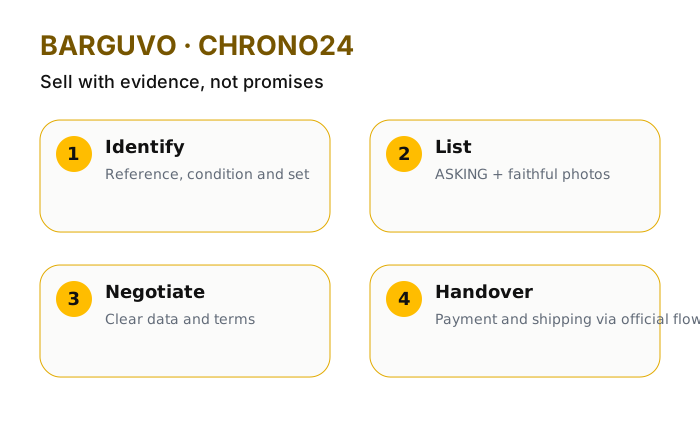
What this guide covers and where Barguvo stops
This guide is intended for a private individual in Spain who wants to prepare and publish a watch on Chrono24 with verifiable information. It focuses on the listing, the fee, the duration, the photos, setting the asking price and moving in an orderly way towards payment, certification and shipping. It does not replace Chrono24's official documentation or create an integration that acts on the user's behalf.
The separation of responsibilities matters because a good listing can contain correct data and still not prove authenticity, full legal ownership or a fair price. Likewise, Chrono24 asking for proof of possession to keep or extend a listing is not the same as certifying the watch. Possession shows a physical relationship with the object; Certified applies a different kind of checks.
Barguvo uses the listing as a piece of evidence, not as a guarantee. The consequential action —publishing, accepting an offer, using escrow, purchasing Certified or shipping the watch— continues on Chrono24.
A final useful distinction is affiliation. Barguvo is not Chrono24, and these pages are non-indexable references for validating architecture, content and UX before production. Mentions of fees, limits and services are documented with official sources and dates. If Chrono24 updates a condition, the platform should not be “forced” to match this guide: the guide is updated. This freshness principle is especially important on high-value marketplaces, where a seemingly small commercial rule can change the net cost or the route of a transaction.
When in doubt, the priority is to keep verifiable facts and make the uncertainty explicit. A somewhat more cautious but consistent listing is better than an emphatic description that the documentation cannot support.
Private individual versus business activity
Chrono24 allows private sellers to list watches, but the current FAQ makes it clear that commercial selling is not allowed under a private account. It also states that the platform may not publish private listings if they appear to constitute business activity. For a person selling part of their collection, the practical criterion is to describe their situation honestly and not use the private mode as a substitute for a dealer account.
There is no special rule that turns a whole collection into a single listing: each watch is listed separately. This means keeping the evidence for each unit separate —reference, condition, photos, accessories, documents and price— and avoids carrying data over from one piece to another for convenience.
Private seller status also affects other rights and later flows. In particular, a private sale does not have the same withdrawal framework as a purchase from a business dealer. That difference is explained in the Protection guide and should not be hidden behind generic commercial terms.
How much it costs to sell: free listing and 6,5 % if the sale is completed
Chrono24's FAQ, reviewed on 26 August 2026, states that publishing a private listing is free and that, if the sale is completed successfully, a fee of 6,5 % of the sale price applies. When escrow is available, the fee is deducted from the amount transferred to the seller. If that service is not available for the transaction and the payment is handled another way, the FAQ explains that the fee may be invoiced.
The 6,5 % is highly time-sensitive data. It should not be presented as a permanent fee or as the fee for business sellers. Nor does it allow you to calculate the real profit without considering the seller's other costs: shipping insurance, packaging, possible external services, applicable taxation or currency differences, depending on the case.
To decide on a useful ASKING, it helps to separate the asking price, the platform fee and the net target. If a seller needs to receive a particular net amount, they can run an arithmetic simulation, but that simulation does not prove that the market will accept the resulting price. The final price still depends on negotiation and on a real transaction taking place.
Duration, extension and listing limit
A private listing stays published for three months. If it does not sell in that period, Chrono24 states that it can be extended for another three months or deleted. To extend it, new proof that the item is still in the seller's possession is required. This possession check is not Certified and does not by itself prove that all the parts of the watch are authentic.
As a private seller, you can publish up to 10 listings at the same time. The limit applies to the private mode; it should not become a licence for commercial activity. If the publishing pattern looks professional, Chrono24 may carry out its own review of the account.
From a quality perspective, an extension should not be automatic either. After three months, it is worth reviewing the photos, condition, available accessories, documentation, recent servicing and ASKING. If the watch has continued to be worn, the original description may have become outdated.
Publication
Active listing
Review evidence
Another 3 months with possession
Preparing reference, condition, accessories and documents
The reference is one of the most important details of a luxury watch because it distinguishes models and, with some manufacturers, specific variants. It must be checked against the papers, invoice or markings available and not inferred from visual resemblance alone. If there is doubt between two references, it is better to declare it and look for additional evidence than to publish an overly precise but incorrect identification.
The condition must describe what exists today: scratches, knocks, bracelet wear, polishing marks, play, crystal, bezel, crown, clasp, observed accuracy and known servicing. “Very good condition” is not a substitute for a description. For vintage or modified pieces, stating replacement or aftermarket components can be crucial for the buyer to interpret authenticity, originality and value.
Box, papers, cards, links, straps, invoices and service documents should only be mentioned if they will actually come with the watch. A photo of a box does not prove that it is the original box for that reference. Nor does an invoice automatically make the current seller the first owner. Each document has a limited scope.
Before publishing, keep your own copy of the evidence and avoid exposing sensitive numbers unnecessarily in public images. Barguvo can help you decide which data serves to prove a characteristic and which data is best kept for a safe verification stage.
For very similar references, also document why you ruled out the alternatives. A photo of the reference number, the warranty card or an invoice can carry more weight than a visual match. If the watch has been customised, separate the base reference from later changes: an added dial, bezel, bracelet or diamonds can alter both the description and price comparability. Do not hide the customisation under the name of the standard model.
Service history deserves a date and a scope. “Serviced” can mean anything from a basic check to a full movement service with parts replaced. If there is an invoice, keep the workshop and the work carried out. If the previous owner only told you about it, present it as unverified information. This distinction prevents an orally transmitted claim from becoming a documented fact within the listing.
Up to 20 photos, but they must represent the real watch
Chrono24 currently allows up to 20 photos to be uploaded to a private listing and asks for the watch to be shown from the important angles, in good quality and with transparency about defects such as scratches or dents. The aim is not to “make the watch look new”: it is to reduce uncertainty for the person assessing that specific unit.
A useful sequence includes the front of the dial, the sides of the case, bezel, crown/pushers, caseback, clasp, bracelet or strap, areas of wear, accessories and relevant documentation. If there is a visible mark, it should appear with enough light and at a reasonable scale. Hiding a defect through reflections, blur or aggressive retouching breaks the chain of evidence even if the image is aesthetically more appealing.
Barguvo's editing rule is strict: “Improve the photo without falsifying the product”. Framing, exposure or background can be corrected reasonably, but you must not erase scratches, alter geometry, change the real colour, add a box or papers that do not exist, reconstruct a bezel or make wear disappear. AI must never modify the apparent condition, identity or real characteristics of the watch.
Also avoid using catalogue photos as if they were of your unit. They can be useful for researching the reference, but the buyer needs to see the watch they will receive. If you use an additional image for explanatory purposes, it must be clearly distinguished from the condition photos.
Lighting should help to read surfaces, not erase them. On polished steel, reflections can hide knocks or polishing lines; alternating diffuse light and raking angles can show the condition better. On dark dials or domed crystals, a front photo and a slightly angled one usually reveal different marks. Colour consistency also matters: an extreme white balance can make a cream dial look white or change the intensity of a patina.
When the watch has serial numbers or sensitive data, decide which part to show publicly and which part to reserve for later verification. Partially covering a number can protect information without preventing the buyer from seeing that an engraving exists. Privacy editing is different from aesthetic editing: hiding a sensitive identifier may be legitimate; reconstructing an illegible number or inventing detail with AI is not.
How to set the ASKING without confusing listings with closed sales
The price you write in the listing is ASKING: a request from the seller. You can compare it with listings for the same reference, but those listings are not closed sales either. A watch listed for months at a high figure does not prove that there is demand at that level.
Chrono24 offers a value estimate based on comparable listings. Barguvo classifies it as ESTIMATE. It can be useful for placing a range, but it still depends on identification, condition and comparable data. ChronoPulse uses aggregated data derived from real transactions and provides a different signal: SOLD-DERIVED AGGREGATE. Neither is equivalent to the exact sold price of your specific watch.
To build a range, compare equivalent references, condition, approximate year, set, servicing, material, configuration and geographic market. Then apply uncertainty. A watch with full papers and recent servicing may not be comparable to another unit with no history; a vintage piece with replaced components may need a more specialised analysis.
Do not turn the estimate into a promise of a “fair price” or a forecast of appreciation. If the financial decision is important, an independent professional valuation can provide another kind of evidence. The VALUATION/VALUE guide explains how to combine the signals.
A useful comparison also takes into account who is selling. A business dealer may include a commercial warranty, returns, inspection or a tax structure that does not exist in a private sale. That is why a dealer's ASKING does not automatically transfer to a private seller. Compare the package of rights and services, not just the big figure on the listing.
Also look at the currency and the place of delivery. A foreign listing may seem cheaper before insurance, shipping, import or taxes. If you convert currencies, record the date of the exchange rate. The aim is not to build a universal formula, but to avoid comparables that are only “similar” once relevant costs have been ignored.
For negotiation, set three internal numbers: the published ASKING, a reasonable deal zone and a walk-away limit. Those numbers can change if new evidence appears, but they should not move under pressure from a single message. If you receive several similar offers from independent buyers, that is a useful qualitative signal about your positioning, even though it is still not a statistic of closed sales.
Making contact and negotiating without weakening the evidence
An interested party may ask for additional details, a new photo or a price proposal. Respond with the same precision you used in the listing. If a contradiction appears —for example, a bracelet that does not match the description— correct the listing before continuing. Consistency between the listing, the messages and the physical watch is more important than gaining speed.
Do not interpret a proposal as a closed sale. Until the parties agree and the corresponding purchase/payment flow is completed, you are still in a negotiation. Keep a record of important price changes and the agreed terms so as not to mix versions.
Avoid unnecessarily leaving the official environment to accept payment links, bank instructions or supposed support messages. The PROTECTION guide explains the difference between a real payment reflected in the corresponding flow and a mere email or screenshot claiming that the money is already available.
When a buyer asks for a specific photo —for example the watch next to a given time or a detail of the clasp— they may be trying to check possession or condition. Meet reasonable requests without exposing unnecessary banking or personal information. An unusual request for full identity documents, security codes or credentials is not part of a normal verification of the watch.
If you agree to include additional accessories or to exclude one that appeared in the photos, record the change in writing in the transaction channel. Most content disputes become harder when the listing, the chat and the parcel describe different sets. Before closing, summarise exactly what is being delivered and in what condition.
When you reach an agreement: payment and escrow are a different owner
Chrono24 can handle many purchases through its escrow account, but the FAQ itself warns that this service is not available in all cases or countries. That is why the selling page must not promise “escrow always”. If escrow appears in the transaction, follow exactly the status Chrono24 shows and do not ship just because an external email says the buyer has paid.
For private sales, the current documentation describes a period of up to seven days after delivery during which the funds may remain held before being transferred to the seller. That hold protects the payment process; it does not authenticate the watch and does not replace Certified. Nor does it turn Chrono24 into the counterparty to the sale: the contract remains between buyer and seller.
The details of Mangopay, availability, private versus business buyer and alternative direct payments are in the PROTECTION/ESCROW guide. Keeping them out of this section prevents the SELL guide from duplicating a payment policy that may change.
When Certified may come in and what it does not mean
Certified adds a layer of authenticity when the watch and the transaction are eligible. For private sellers, the current FAQ includes Spain and requires, among other criteria, an accepted brand and a final price between 5.000 and 25.000 euros. Specific availability must be checked on the listing and in the current flow, not inferred solely from the watch's value.
A buyer purchasing Chrono24 Certified does not turn the ASKING into a fair price or guarantee full provenance, future condition or the absolute originality of every factory component. The programme applies its own definition of authenticity and sets out how declared replacement or aftermarket components are treated.
That is why the right strategy is to describe the watch accurately before knowing whether Certified will appear. Certification must not be a licence to omit known defects or history. See the CERTIFIED/AUTHENTICITY guide for requirements and limits.
Shipping and evidence before handover
Before shipping, confirm the address and the payment status within the corresponding official flow. Chrono24's FAQ recommends stable packaging and valid shipping insurance for valuables that covers the full value of the watch. A policy's exclusions can be as important as the declared amount.
Document the condition just before closing the parcel: photos of the watch, accessories included, number of pieces, packaging and label. That evidence does not prevent an issue, but it helps reconstruct what was handed to the carrier. Do not publish sensitive numbers if they are not necessary; keep private dated copies.
If Certified is part of the flow, the initial destination may be a certification workshop rather than the buyer. Do not improvise another route. If the escrow service is not available, do not assume that an alternative payment method offers the same protection either. Every change of flow alters the risk and must be reassessed.
Insurance deserves a specific check because some courier policies exclude jewellery or watches above certain amounts. “Insured parcel” does not necessarily mean “watch covered for its full value”. Read the limits, exclusions, packaging requirements and proof of value before choosing the service. For high-value pieces, a specialised carrier or additional cover may be necessary.
Keep the tracking number and proof of delivery, but do not publish the buyer's address or other personal information in public screenshots. If a loss occurs, open an issue with the carrier and the Chrono24 flow as appropriate. Do not allege fraud before distinguishing between a delay, a scanning error, a damaged parcel or a content discrepancy.
Final checklist before continuing on Chrono24
Before pressing publish, check that the reference, brand, model, condition and accessories describe that unit; that the photos are current and show defects; that the ASKING is not presented as SOLD; that you understand the current fee and the 3-month horizon; and that you are not using a private account for business activity.
Also check what information you will keep outside the listing: invoice, proof of purchase, service documentation, packaging photos and relevant communications. If the watch has replaced parts, stating this before negotiation reduces the risk of authenticity and originality being confused.
Once the listing is consistent, continue on Chrono24. Barguvo can review the logic of your decision, but it does not publish or act on your behalf.
Before publishing a particularly valuable piece, do a contradiction review: compare the title, reference, declared year, material, condition, set and price with what the photos and documents show. A small discrepancy may be innocent, but if it is not corrected it spreads to messages, offers and shipping. The best time to resolve it is before there is a buyer waiting for a reply.
Also define what would change your decision. For example: “if a recent service invoice turns up, I keep the ASKING; if I discover an undeclared service dial, I review the description and range”. Writing these criteria down before negotiating reduces impulsive decisions and makes clear which evidence is really material.
Finally, review how fresh Chrono24's rules are. Fees, limits, Certified countries and payment flows are P0 data. This reference is dated 26/08/2026; if the platform shows different conditions, the official information current at the time of acting prevails.
Related Chrono24 guides
These owners separate listing, payment, authenticity and value to avoid incorrect conclusions.
Barguvo helps to organise information, detect contradictions and prepare decisions. It does not act as seller, buyer, certifying watchmaker, payment provider, carrier or contractual counterparty of Chrono24.
Organise evidence, price, risks and next steps before acting.
Listing, purchase, payment, Certified or valuation is completed on the original service.
Official sources and review date
Review: 26/08/2026. Fees, requirements, countries, prices and timings are dynamic data: they must be verified again if Chrono24's documentation changes.
FAQ
Is publishing a private listing free?
Yes. The FAQ reviewed on 26/08/2026 states that publishing is free; it charges 6,5 % if the sale is completed.
When is the 6,5 % charged?
When the sale is completed successfully. With escrow it may be deducted from the payment to the seller; if escrow is not available, the FAQ provides for invoicing.
How long does a private listing last?
Three months. If it does not sell, it can be extended for another three months with new proof of possession.
How many private listings can I have?
The current FAQ states up to 10 at the same time; a private account must not be used for commercial activity.
How many photos can I upload?
Up to 20 photos according to the current FAQ, showing the watch and its defects transparently.
Does proof of possession certify authenticity?
No. It confirms possession for the corresponding flow; Certified is a different layer.
Can I sell professionally with a private account?
It should not be done. Chrono24 separates private selling from the activity of business dealers.
Does Barguvo publish or collect payment for me?
No. Barguvo prepares the analysis; publishing, payment collection, Certified and delivery continue on Chrono24.
Barguvo is an independent assistant and is not affiliated with Chrono24. Sources reviewed on 26/08/2026.