
Why “value” is not a single number
A watch can have, at the same time, a listed price, an algorithmic estimate, an updated collection value and a market signal derived from real transactions. Those numbers answer different questions. Reducing them to “the true value” creates a precision the market does not offer.
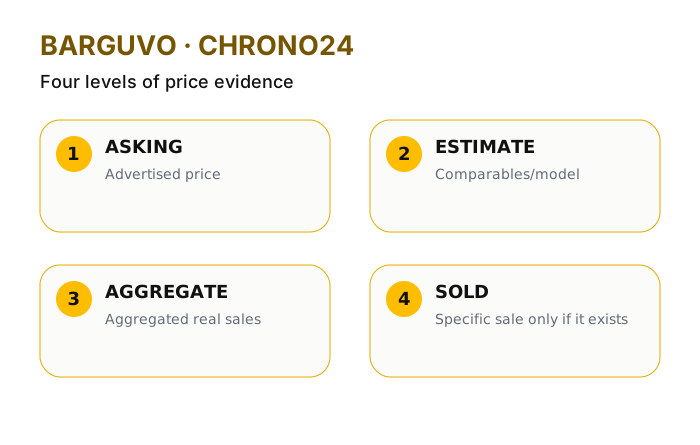
Barguvo uses an evidence ladder. ASKING is what a seller asks for. ESTIMATE is an output calculated from comparables or models. SOLD-DERIVED AGGREGATE summarises real transaction data at index or group level. SPECIFIC SOLD TRANSACTION would be a specific, provable sale comparable to your watch. We must not jump from one level to the next without evidence.
How Chrono24’s free estimate works
The estimate page lets you select a model and condition to obtain a free reference. Chrono24 explains that it compares the watch with a very large corpus of global listings. The current landing page mentions 600.000 listings; the FAQ has used “more than 500.000”. As both are current first-party sources, Barguvo does not pretend there is no conflict and publicly uses “hundreds of thousands of listings”.
A listings-based methodology can be useful because it captures observable supply, references, stated condition and dispersion. But an active listing is still an intention to sell. Just by seeing it we do not know whether it will close, whether there will be a discount or whether it will disappear without a transaction.
That is why the estimate is classified as ESTIMATE. Even when the page itself uses commercial expressions such as “professional valuation”, Barguvo does not turn it into an individual expert appraisal of a physically examined watch.
What comparing with listings means and how to avoid false comparables
Two watches with the same commercial name may not be comparable if the reference, size, material, year, dial configuration, bracelet, set, condition or servicing differ. A large database does not replace correct identification. If the model entered is wrong, the apparent precision of the result can be misleading.
The stated condition is also a source of noise. Two sellers may describe the same level of wear differently. An aggressively polished watch may look shiny but have a different case profile; a vintage piece with a service dial may be valued differently from one with a well-preserved original dial.
Before taking an ESTIMATE as a useful range, check which variables you know and what uncertainty remains. If the reference or authenticity is missing, resolve those first. If the watch is rare and there are few comparables, the system itself may have less information.
Watch Collection: daily estimates do not mean daily certainty
The current FAQ states that Watch Collection’s estimated values are calculated daily, although it clarifies that value fluctuations become visible over longer periods of time. Frequent updating is a technical feature of the estimate, not a guarantee that the real economic value changes every 24 hours.
Watch Collection is useful for tracking a collection and observing trends, but it is still an estimated output. Do not turn a rise in the app into a realised profit. Until you sell and know the final net price, the gain is theoretical.
For rare watches, the FAQ itself acknowledges that there may be little data; the information is updated when more listings and enough data appear. That limitation should increase the uncertainty of the analysis, not push you to fill the gap with an invented figure.
What ChronoPulse is and why it provides another kind of evidence
ChronoPulse is Chrono24’s global price index for pre-owned watches. The current page states that it is based on more than 600.000 transactions and analyses 140 watches from 14 major luxury brands with high volume in the secondary market. It also says explicitly that it uses real sales figures and transaction data.
That allows ChronoPulse to be classified as SOLD-DERIVED AGGREGATE: there are real sales behind the index. It is a signal closer to activity actually carried out than a set of listings, but it is still aggregated. It does not automatically reveal the sold price of the exact reference in front of you.
ChronoPulse is global. Do not turn an index trend into “the Spanish market” unless Chrono24 publishes a specific geographical breakdown. Nor should you extrapolate from the major brands to watches that are not part of the universe analysed.
What “real sales” means at index level
An index can use real transaction prices and still not be a table of unit sales. The data are grouped to measure how a set evolves. If ChronoPulse rises, that does not mean that all the references included have risen by exactly the same amount, much less that each individual unit reaches the index value.
Its usefulness lies in putting segment trends and liquidity in context. It can help you question a listing whose ASKING ignores a broad fall, or understand a recovery period. To set a specific price you still need comparables for the reference, condition and set.
An editorial report by Chrono24 analysing completed transactions can also be SOLD-DERIVED evidence, but only within its population and methodology. Barguvo will not copy a global conclusion onto an individual reference without checking the bridge between the two.
ASKING vs ESTIMATE vs SOLD-derived: a practical example
Imagine a watch listed at 8.900 €. That figure is ASKING. The Chrono24 tool returns a range estimate based on comparables: ESTIMATE. ChronoPulse shows that the brand’s segment has trended downwards over a period: SOLD-DERIVED AGGREGATE. None of those three pieces on its own tells you that an exactly comparable unit sold for 8.200 €.
To reach SPECIFIC SOLD evidence you would need a source that documents the specific transaction and is comparable in reference, condition and context. On many marketplaces that evidence is not publicly available. The absence of a specific SOLD does not authorise renaming an ASKING price as a sold price.
The practical decision is to work with a range and a confidence level. If the ASKING is outside the range of comparables, ask for an explanation: exceptional condition, full set, servicing, rarity or simply the seller’s ambition. If there is no justification, adjust your confidence.
Specific factors that can move a watch’s value
Reference and variant are the starting point. Then come case and dial condition, polishing, bracelet and links, box/papers, service history, replaced components, configuration, rarity and demand. In vintage, small details can have much greater impacts than in plentiful modern references.
Authenticity is a requirement separate from value. Certified can reduce uncertainty about authenticity, but it does not guarantee complete originality or a fair price. Likewise, an authentic piece may need a costly service. That expected cost should form part of your range.
Liquidity matters too. Two models with a similar “estimated value” can take very different times to find a buyer. Barguvo avoids turning time-to-sell into an invented figure if there is no solid evidence for that reference and market.
How to combine signals to set a range, not a promise
Start by identifying the watch and separating strong comparables from weak ones. Use the Chrono24 estimate as a reference for the listed market; check the aggregated trend when ChronoPulse covers the segment; add documentary evidence of condition, set and servicing; and keep a margin for negotiation, fees and costs.
Express the result as a range with assumptions. An interval can have a more likely central zone and limits that depend on an inspection. If the authenticity or the reference is pending, the range must reflect that uncertainty instead of offering a precise figure.
For a seller, the ASKING can be placed above the net target if there is room for negotiation, but it must remain defensible. For a buyer, a big discount compared with an estimate is not automatically a bargain: it may signal condition, parts, urgency or fraud. A low price does not replace due diligence.
A useful range should also state its date. In collector markets, a reasonable estimate today can become outdated if liquidity changes, a new reference appears, supply shifts or the currency moves. Recording the date of the query lets you compare later without pretending all observations belong to the same market.
When to ask for an independent professional valuation
If the watch is high-value, vintage, rare, inherited or modified, or there is an authenticity conflict, an independent valuation can provide a physical inspection and a professional responsibility that an automatic tool does not offer. That is especially useful for insurance, inheritances, litigation or wealth decisions.
A professional valuation is not magically a guaranteed sale price either. It must document the purpose, date, methodology and condition of the watch. It may differ from Chrono24’s liquid market because it serves a different purpose.
Barguvo always distinguishes `BARGUVO_ESTIMATE` from `PROFESSIONAL_APPRAISAL`. Our analysis can organise data and point out uncertainty, but it does not replace an expert appraisal.
Common mistakes when interpreting Chrono24 figures
The first mistake is calling a listing “sold”. The second is believing that a daily estimate is a physical valuation. The third is using ChronoPulse as if it revealed the exact price of each watch included. The fourth is assuming that Certified automatically raises the value.
Another mistake is taking a comparables figure as stable. The current first-party pages even show two different magnitudes for the listings corpus —approximately 600.000 versus more than 500.000—. The rigorous way to handle this is to acknowledge the conflict and use conservative language, not to pick the number that seems most impressive.
Finally, do not turn a past trend into a future promise. A historical index describes observed data; it does not guarantee appreciation. If the aim is investment, you need a separate risk analysis.
It is also a mistake to mix the gross price with the net result. For a seller, fees, insurance and other costs reduce what they finally receive. For a buyer, shipping, taxes or a later service can increase the total cost. The market signal and the personal economics of the transaction are different layers.
Related Chrono24 guides
These dedicated guides separate listing, payment, authenticity and value to avoid incorrect conclusions.
Barguvo helps organise information, detect contradictions and prepare decisions. It does not act as seller, buyer, certifying watchmaker, payment provider, carrier or contractual counterparty of Chrono24.
Organise evidence, price, risks and next steps before acting.
Listing, purchase, payment, Certified or valuation are completed on the original service.
Official sources and review date
Review: 26/08/2026. Fees, requirements, countries, prices and timeframes are dynamic data: they must be checked again if Chrono24’s documentation changes.
FAQ
Is the Chrono24 valuation a real sale price?
No. It is an estimate based on comparables and model data, not a specific transaction.
How many listings does the estimate use?
The current first-party sources differ: the landing page speaks of around 600.000 and the FAQ of more than 500.000. Barguvo uses “hundreds of thousands”.
Why not simply pick 600.000?
Because there is another current first-party figure. Hiding the conflict would produce false precision.
Does ChronoPulse use real sales?
Yes. The current page says it is based on more than 600.000 transactions and real sales figures.
Can I use ChronoPulse as SOLD for my specific reference?
No. It is aggregated evidence; it does not automatically reveal a specific comparable transaction.
Is Watch Collection a professional valuation?
It should not be treated as one. Its values are recalculated daily as estimates.
Does Certified automatically increase the value?
No. Certified focuses on authenticity within the programme; it does not set market value.
What is the difference between ASKING and SOLD?
ASKING is what a seller asks for; SOLD requires evidence of a completed transaction.
Barguvo is an independent assistant and is not affiliated with Chrono24. Sources reviewed on 26/08/2026.