
What escrow is and what problem it tries to solve
Escrow separates two moments that can be hard to coordinate in a distance sale: the buyer hands over funds and the seller hands over a watch. On many listings, Chrono24 allows the payment to go through an escrow account before the money is transferred to the seller. That mechanism reduces one type of payment risk, but it does not make every transaction identical or remove the need to review the watch, the seller and the terms.
The current FAQ also includes a fundamental caveat: escrow may not be available depending on the buyer's or seller's country and on the transaction. If it does not appear, the parties may agree on another payment method. Barguvo will not treat a direct payment as equivalent to escrow or write “Chrono24 always holds the money”.
The guide focuses particularly on sales between private individuals because the period after delivery and the return rights are not the same as with a business dealer.
The word “protection” must always be read together with its scope. A flow may protect funds against a delivery that has not yet been completed and, at the same time, leave other questions —condition, originality, contractual interpretation— outside that layer. This precision prevents a security icon from becoming a total promise.
Private flow step by step: order, funds, shipping, delivery and payment
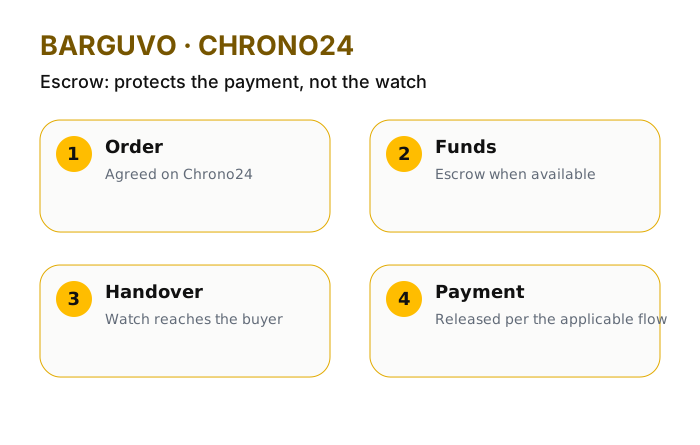
In a compatible private transaction, the buyer places the order on Chrono24 and pays using the options the platform offers for that listing. The seller must check the actual status of the transaction in their account, not rely solely on an email, screenshot or forwarded message.
When the funds are in the escrow flow, the seller prepares the watch and ships it following the relevant instructions. Delivery does not mean the money has to be released at that same instant. In Chrono24's current documentation for purchases from private sellers, the amount may be kept in the escrow account for the seven days following delivery before payment to the seller.
The purpose of the period is to allow the delivery process to settle within the protection Chrono24 describes. It should not be interpreted as an automatic authenticity inspection. If Certified has been purchased, that certification is a separate process; if it has not, escrow does not replace a review of the watch.
The exact flow visible in the transaction takes precedence over any editorial summary. If an official screen shows an additional step, a different time limit or that escrow is not available, follow that up-to-date information.
The purchase is agreed
Escrow if available
The watch is received
Transfer according to the flow
For the buyer, confirmation that the funds have gone into escrow does not replace reviewing the listing. Before paying, it must be clear which watch, reference, condition, accessories and terms are being bought. For the seller, confirmation of payment does not allow them to change the contents of the delivery unilaterally either. Escrow coordinates money and delivery, but the accuracy of the object still depends on the sale itself.
What “up to 7 days” really means in a purchase from a private seller
The Certified page and the FAQ distinguish the business case from the private one. For a purchase from a private individual, Chrono24 states that it keeps the amount in escrow for the seven days following delivery. This does not create a general legal right of withdrawal against a private individual. The holding period and return rights are distinct legal and operational concepts.
For a purchase from a business dealer, Chrono24's documentation refers to a 14-day period and links it to the legal right of withdrawal. Do not carry those 14 days over to a private seller. The seller's identity is therefore a variable that changes how to interpret the same «Protección al Comprador» (Buyer Protection) icon or message.
“Up to seven days” also does not mean that any dispute will be resolved automatically in favour of the buyer or the seller. Evidence of condition, delivery and communication is still necessary. Barguvo recommends keeping screenshots of the official flow and shipping documentation when there is an issue.
When escrow may not be available
Chrono24 says that many listings can be processed directly through its flow, but if the seller does not offer that option the buyer may have to contact them directly and agree on payment and shipping terms. The private seller FAQ adds that, in some cases, escrow is not available to the buyer.
That is why a correct guide cannot promise universal coverage just because you are on Chrono24. Country, listing, seller, amount, payment method and internal checks can affect availability. Before negotiating on the basis of a specific protection, confirm that this protection actually appears in the transaction.
If there is no escrow, paying the seller directly changes the risk. A bank transfer may be valid as a means of payment, but it does not on its own have the same holding mechanism. Do not send money to a different account because someone says “it is the Chrono24 account”; verify the details within the official flow.
What role Chrono24 plays, what role Mangopay plays and who is actually selling
The current FAQ identifies Mangopay as the payment service provider used by Chrono24. This helps to understand that the payment infrastructure has a specialised provider, but it should not be used as an argument that Mangopay or Chrono24 guarantee the condition of the watch.
Chrono24 also states expressly that the contractual partner in the sale is always the seller: dealer or private individual. The platform offers marketplace, purchase process, payment, protection and support services depending on the case, but it does not replace the counterparty who transfers the watch.
This separation matters in claims. A payment issue may belong to the platform's flow; a contractual discrepancy about what was sold may depend on the buyer-seller relationship and the applicable rights. Barguvo does not consider a conflict resolved just because the payment went through escrow.
The name of the payment provider may change over time or vary by jurisdiction. That is why Mangopay is presented as current revalidated data, not as a permanent property of Chrono24. If the official flow shows another provider or a different entity, that current information must prevail. The user should never choose an account because it matches a name seen in an old guide.
Private versus business seller: returns and withdrawal are not the same
One of the most costly confusions is assuming that any online purchase comes with 14 days to return. Chrono24 warns that the legal right of withdrawal does not apply in the same way to purchases from private sellers. For purchases from business dealers, its material links the protection to the 14-day legal period.
This does not mean that a private individual can falsely describe a watch or that the buyer has no possible recourse in the event of a breach. It means that you should not automatically import the B2C regime into a private relationship. The jurisdiction and the specific circumstances may matter.
Before buying, identify the type of seller shown on the listing and keep the terms visible at that moment. If you need legal advice for a specific dispute, the Barguvo guide does not replace a professional.
A business listing may also include commercial warranties or dealer policies that add rights on top of the legal minimums. In a private sale there may be specific contractual agreements between the parties. What matters is to read the type of seller and the specific terms, instead of assuming that the Chrono24 logo makes all legal relationships uniform.
What escrow does NOT check
Escrow protects the payment sequence within the scope Chrono24 documents. It does not authenticate the reference, measure accuracy or water resistance, verify each component, reconstruct provenance, determine market value or guarantee that the watch will work in the future.
Nor does it make a listing “safe” in every sense. A listing may contain errors even if the payment is handled correctly. Likewise, an authentic watch may be overpriced or need servicing. For authenticity there is Certified where eligible; for value there is valuation and ChronoPulse; for the final decision an independent inspection can be useful.
Barguvo maintains this matrix: `ESCROW != AUTHENTICITY != CONDITION != FAIR PRICE != UNIVERSAL REFUND`. Mixing these concepts produces a false sense of protection.
Certified is a different layer
Chrono24 Certified can be added optionally by the buyer on eligible transactions and uses watchmakers to carry out authenticity checks. If it is purchased, the seller may have to send the watch to the relevant workshop first. That route changes the logistics, but it does not change the nature of escrow: they are separate layers.
A satisfactory Certified result provides a digital certificate and the programme's authenticity guarantee, but it does not make the payment reversible without limit or the price “fair”. If the transaction is private, the buyer's rights are still those that apply to a private sale.
The CERTIFIED guide explains country, price, brands, cost and limits. Here it is enough to know that “protected payment” and “certified authenticity” are not synonyms.
Before shipping or handing over: check the real payment and keep evidence
The seller should never ship based solely on an email claiming that the payment has been made. Chrono24's own help pages insist on checking the actual payment status. A phishing message can copy a platform's name, design and language; the source of truth is the account and the corresponding official flow.
Before shipping, document the watch, accessories, packaging, address and carrier. Use insurance that genuinely covers watches and the value of the piece. If the transaction requires Certified, use the certification workshop address shown in the process, not an address sent by a third party.
For an in-person handover, the principle is similar: do not consider a banking screenshot irrevocable, and do not hand over documentation or the watch until you understand the applicable payment confirmation. If the method departs from the flow originally agreed, reassess before continuing.
Signs of a fake payment confirmation or a change of flow
A request to pay a “release fee”, a bank account that appears only in a private message, pressure to ship before the status changes in the account, a lookalike but unofficial domain or a screenshot that cannot be verified are all signs to stop.
The fact that the other person knows details of your listing does not prove that they represent Chrono24. Part of the information is public. Do not install remote access software or share security codes to “receive” a payment. A legitimate provider does not need you to hand over online banking credentials to confirm a transfer.
If in doubt, go back to Chrono24 manually from your browser or app and use its support channels. Do not follow the link contained in the suspicious message to “verify” the message.
Protected transaction checklist
Confirm the type of seller, the actual availability of escrow, the amount, the shipping address and the payment status. Check whether Certified has been purchased and what logistics route it requires. Keep documentation of the watch's condition before shipping it and of the parcel handed to the carrier.
For a private purchase, remember that the seven-day period of held funds is not equivalent to the legal right of withdrawal for a business purchase. If a problem arises, document the facts and timings first before alleging fraud or fault.
Finally, do not leave the official perimeter just to gain speed. If an alternative payment method is necessary because escrow does not exist, treat it as a different flow and understand its real protection before handing over money or the watch.
If the watch arrives with a discrepancy, keep the packaging, label, unboxing photos and communications before returning, repairing or handling the piece. Acting hastily can destroy useful evidence. Contact the relevant official flow and describe observable facts: piece received, specific difference, date, payment status and documentation available.
For high amounts, also prepare an escalation plan: what documentation you will keep, which official channel you will use and what you will do if the tracking stops or the buyer reports a discrepancy. Having the plan before shipping helps you avoid improvising under pressure and distinguish a logistics issue from a contractual dispute or a fraud attempt.
Do not delete messages or alter the watch while an issue is open unless the official procedure requires it. Contemporaneous evidence —photos, account status, tracking and agreed contents— is usually more useful than a later reconstruction from memory.
Related Chrono24 guides
These owners separate listing, payment, authenticity and value to avoid incorrect conclusions.
Barguvo helps to organise information, detect contradictions and prepare decisions. It does not act as seller, buyer, certifying watchmaker, payment provider, carrier or contractual counterparty of Chrono24.
Organise evidence, price, risks and next steps before acting.
Listing, purchase, payment, Certified or valuation is completed on the original service.
Official sources and review date
Review: 26/08/2026. Fees, requirements, countries, prices and timings are dynamic data: they must be verified again if Chrono24's documentation changes.
FAQ
Does Chrono24 always hold the money?
No. Many orders use escrow, but the FAQ says it may not be available in some countries or transactions.
How long are funds held when buying from a private seller?
The current documentation refers to the 7 days following delivery before transferring to the private seller.
Does escrow guarantee authenticity?
No. Escrow protects the payment process; Certified is a different authenticity layer.
Is Chrono24 a party to the sale contract?
The FAQ states that the contractual partner is the seller, whether a dealer or a private individual.
Do I have 14 legal days to return to a private seller?
It should not be assumed. Chrono24 distinguishes the right of withdrawal for business purchases and points out that it is not provided for in the same way by law for private purchases.
What happens if escrow is not available?
The parties may agree on another means of payment; it should not be presented as equivalent protection.
What role does Mangopay play?
Chrono24 currently identifies it as its payment service provider.
Should I ship if I receive an email saying they have already paid?
Not on the strength of the email alone. Check the actual status in the official flow before shipping.
Barguvo is an independent assistant and is not affiliated with Chrono24. Sources reviewed on 26/08/2026.